

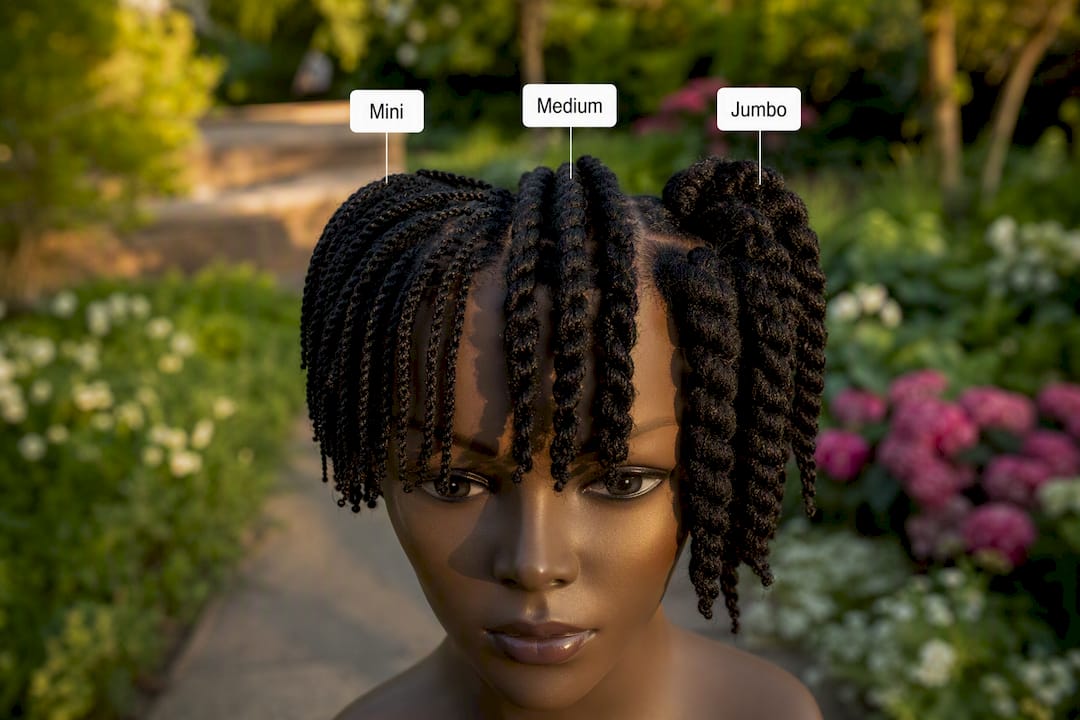
Three twist families cover almost every look you will find in a salon lookbook: two-strand twists, flat twists, and extension-based twists like Senegalese, Marley, or passion twists. All three protect your natural hair while it grows, and all three unravel into a twist-out when you take them down. The main variable is size. Mini twists deliver volume and definition. Medium twists give you the most styling range. Jumbo twists get you out the chair fastest with the least manipulation.
- Two-strand twists: the base technique, works on loose or extended hair
- Flat twists: twisted flat against the scalp, lower tension, gentler on sensitive edges
- Extension twists (Senegalese, Marley, passion): added length and volume, longer wear
- Sizing rule: mini for definition, medium for versatility, jumbo for speed
Key Takeaways
Twist size determines wear time and daily upkeep more than any other styling choice, and previewing that choice on your own face beats guessing from a gallery photo.
| Point | Details |
|---|---|
| Pick size by lifestyle first | Mini twists suit those who want weeks of definition; jumbo twists suit those who want speed and low upkeep. |
| Flat twists protect sensitive scalps | Their lower tension makes them a gentler option than cornrows for stressed edges. |
| Follow the three install rules | Keep hair damp not wet, use even tension root to tip, and seal every end. |
| Match extension fiber to tolerance | Marley gives a matte, kinkier look while Kanekalon is shinier and lighter in weight. |
| Preview before you book | Stylemycrown's virtual try-on lets you test twist sizes and parting patterns on your own photo using free trial credits. |
Table of Contents
- Twist Hairstyles Black Hair Lovers Actually Wear
- How Do You Choose the Right Twist Size and Technique?
- Installing and Maintaining Twists That Actually Last
- Preview Twist Sizes and Styles Before You Book
- What Most Advice Gets Wrong About Choosing a Twist Style
- Try Before You Twist: Preview Styles With StyleMyCrown
- Sources
Twist Hairstyles Black Hair Lovers Actually Wear
A good twist gallery does double duty. It shows you what is possible, and it tells you what each look actually costs in time and upkeep. Here are twelve twist styles worth bringing to a mirror, or to a stylist, before you commit.
- Mini twists. Tiny, uniform sections that read as texture rather than individual strands. Best on 3c to 4c hair and shoulder length or longer. Wear time runs two to three weeks on natural hair, and stylists recommend mini twists specifically when a client wants long-lasting definition and volume over speed. Salon session recommended for the first install.
- Medium two-strand twists. The default for a reason: faster to install than minis, holds three to four weeks, and works across most curl patterns from 3b to 4c. DIY-friendly once you have practiced parting.
- Jumbo twists. Thick sections, fast install, minimal manipulation. Wear time tends to be shorter on natural hair, as the weight and size make them loosen sooner. Great for a quick protective style before a trip.
- Flat twist updo. Two rows of flat twists swept into a bun or pinned crown. Ideal for fine or thinning edges since the technique needs less tension than cornrows. DIY-friendly with practice.
- Senegalese twists. Extension-based, rope-like, and glossy. Typically a salon service given the sectioning precision required. Lasts four to six weeks with care.
- Marley or Havana twists. Chunkier, kinkier texture using Marley hair extensions for a matte, natural finish. Heavier than Kanekalon-based styles, so factor in scalp tolerance before booking a full head.
- Passion twists. Bohemian, curly ends using pre-looped extension hair. Popular for a softer look than Senegalese. Salon recommended.
- Kinky spring twists. Extension twists using pre-curled kinky hair for a natural, springy texture without heat. Salon installed, six-week wear typical.
- Twist bob. Short, chin-length twists, either natural or with light extensions. Low weight, easy upkeep, good for readers testing twists for the first time.
- Twist ponytail. Any twist size gathered and wrapped for a sleek, off-the-face look. DIY-friendly and reversible daily.
- Half-up with beads. Front twists pulled back, ends left loose or beaded. A styling variation rather than a new install, works on mini or medium twists.
- Twist-out texture. Not a twist itself, but the coiled, defined result once twists come out. This is where the versatility of twist styles really shows.
Quick fact: Extension fiber choice changes more than you'd expect. Marley gives a kinkier, matte finish while Kanekalon reads shinier and lighter, and that tradeoff between look and weight tolerance should guide which extension type you pick, not just the style photo you liked.
How Do You Choose the Right Twist Size and Technique?
Size determines almost everything about how a twist style feels to wear, not just how it looks. A smaller section means more twists, more install time, and a longer hold. A larger section means fewer twists, faster application, and a shorter lifespan before frizz sets in.
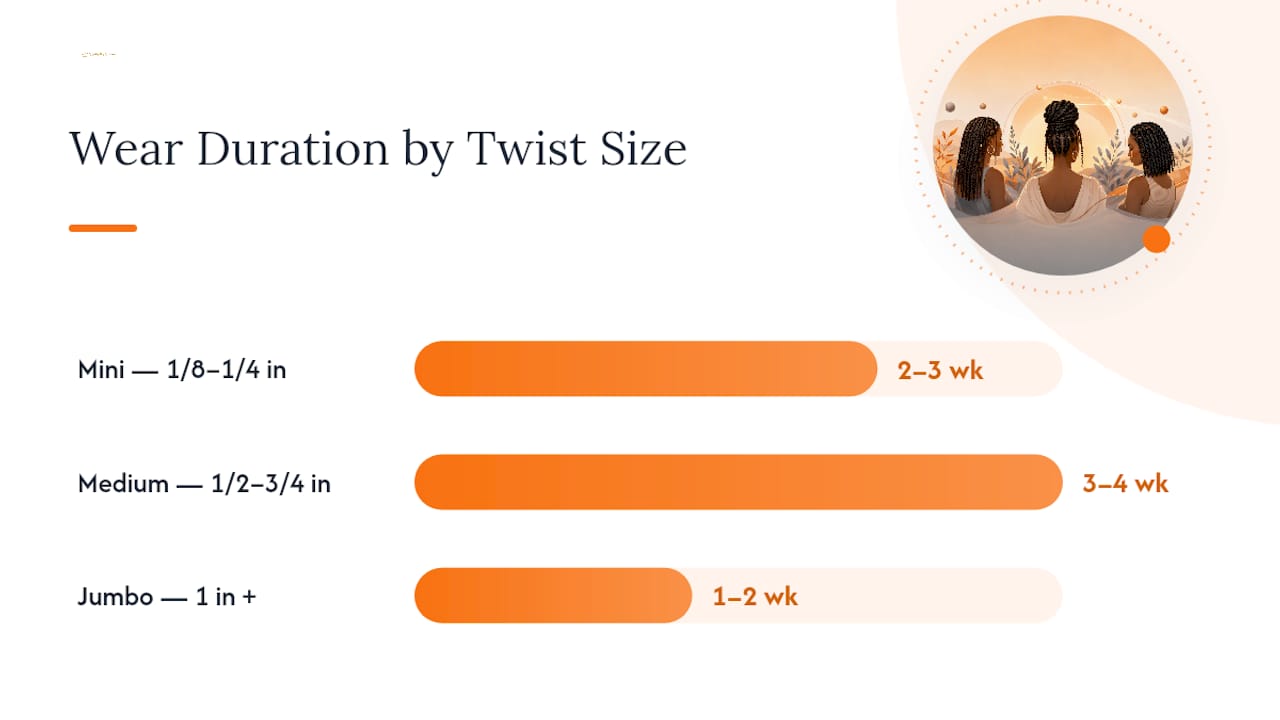
Mini twists use sections roughly 1/8 to 1/4 inch wide. Expect the longest install time and the longest wear, two to three weeks on natural hair. Medium twists run about 1/2 to 3/4 inch. They install faster than minis and hold three to four weeks while still supporting updos and defined twist-outs, which is why they work as a default for first-timers. Jumbo twists use 1-inch-plus sections, install in the least time, and last one to two weeks before they loosen from their own weight.
Curl pattern matters too. Looser 3b to 3c patterns tend to hold twist definition longer with less product, while denser 4a to 4c patterns often need extra moisture and a firmer twisting cream to prevent frizz from creeping in early. Two-strand twists themselves are adaptable across that entire range, which is part of why they show up in nearly every protective style rotation.
Before booking anything, run through this checklist:
- How much daily time can you realistically give to upkeep?
- Is your scalp sensitive to tension or tight parting?
- Do you want two weeks of wear or six?
- What is your budget for extensions versus a natural set?
Your product and tool stack should include a leave-in conditioner, a twisting cream or butter for hold, a lightweight gel for edges, a rat-tail comb for clean parts, sectioning clips, and a satin bonnet for nights.
Pro Tip: When you talk to a stylist, describe section width in inches, not just "small" or "big." Say "quarter-inch sections, natural set, no extensions" instead of "mini twists," since that language ties directly to install time and price.
Flat twists deserve a specific mention here. Because they use less tension than cornrows, they are often the better call if your scalp is sensitive or your edges are already stressed.
Installing and Maintaining Twists That Actually Last
Three rules separate a twist that holds for weeks from one that frizzes by Friday: hair should be damp, not soaking wet, tension needs to stay even from root to tip, and every end has to be sealed. Skip any one of those and you're rebuilding twists sooner than planned, according to installation guidance built around exactly these three non-negotiables.
Install time varies by size. Mini twists run two to four hours. Medium twists take an hour and a half to two and a half hours. Jumbo twists can be done in one to two hours. Add extensions to any size and expect more time on top of those estimates.
A simple four-step home install looks like this:
- Cleanse and deep condition, then detangle section by section, not all at once.
- Apply a leave-in conditioner while hair is still damp, followed by a twisting cream or butter.
- Part cleanly with a rat-tail comb, then twist with even tension from root to tip.
- Seal each end with a small amount of gel or edge control, twirling between fingers until it coils.
At night, wrap with a satin bonnet or sleep on a satin pillowcase to cut friction and frizz. A light oil at the scalp every few days keeps skin from drying out under the twists. Once a week, refresh edges and check for loosening at the roots. When you're ready to take them down, work in small sections, apply a light oil, and gently separate strands with your fingers rather than a comb to keep a twist-out fluffy instead of fuzzy.
Preview Twist Sizes and Styles Before You Book
Choosing between mini, medium, and jumbo twists gets a lot easier when you can actually see the option on your own face first. Stylemycrown's virtual try-on tool uses augmented reality to place any of its 528 curated styles onto your photo, built specifically around the texture range of Black hair rather than a generic hair-app filter.
That matters most when a style choice is really a size or parting decision, since previewing different parting patterns and sizes reduces salon miscommunication and helps you land on a silhouette that actually flatters your face shape.
A few practical ways this helps before you sit in a chair:
- See how a jumbo twist changes your silhouette compared to medium twists, without committing to either
- Test how Senegalese or passion twist length and volume would sit on your face shape
- Compare a flat twist updo against a loose twist ponytail side by side
- Try ten complimentary credits before deciding whether a subscription is worth it for ongoing styling decisions
What Most Advice Gets Wrong About Choosing a Twist Style
Most twist guides treat size as an aesthetic preference, something you pick based on which photo you like best. That is backward. Size is a scheduling decision disguised as a style decision. Mini twists mean a longer chair time and inconsistent stretches between reinstalls, and that discipline either fits your calendar or it doesn't. Jumbo twists trade that discipline for less wear time, not less commitment.
The other blind spot is treating flat twists as a lesser cousin of two-strand twists instead of what they actually are: a legitimate low-tension option for anyone whose scalp cannot handle another round of tight parting. That deserves more attention than it gets in most gallery-style articles, which bury flat twists as an updo base rather than a standalone protective choice.
If there is one thing to prioritize before anything else, it's matching size to your actual weekly routine, not your Pinterest board. Everything else, extension fiber, parting pattern, styling flourish, is a downstream decision once that's settled.
— Christelle
Try Before You Twist: Preview Styles With StyleMyCrown
Booking a twist install on a guess is how people end up with jumbo twists when they wanted definition, or mini twists when they didn't have the weekly time for upkeep. Stylemycrown removes that gamble. Ten complimentary credits let you run a photo through the Style Catalog and see how mini, medium, or extension-based twists actually sit on your face before you spend a cent or a Saturday.
Take the photo in natural light, front facing, hair pulled back from your face for the clearest read. Pick two or three styles from the gallery above (a medium two-strand twist, a flat twist updo, maybe a passion twist for contrast) and run each one through the try-on. Save the results and bring them to your next appointment through the Stylist Catalog, so your stylist starts from a picture of your actual face instead of a stranger's.
Sources
- 34 Low-Maintenance Twist Hairstyles to Try This Season
- 30 Two-Strand Twist Hairstyles + How-To Guide (2026)
- Flat twists: benefits and how to do them