
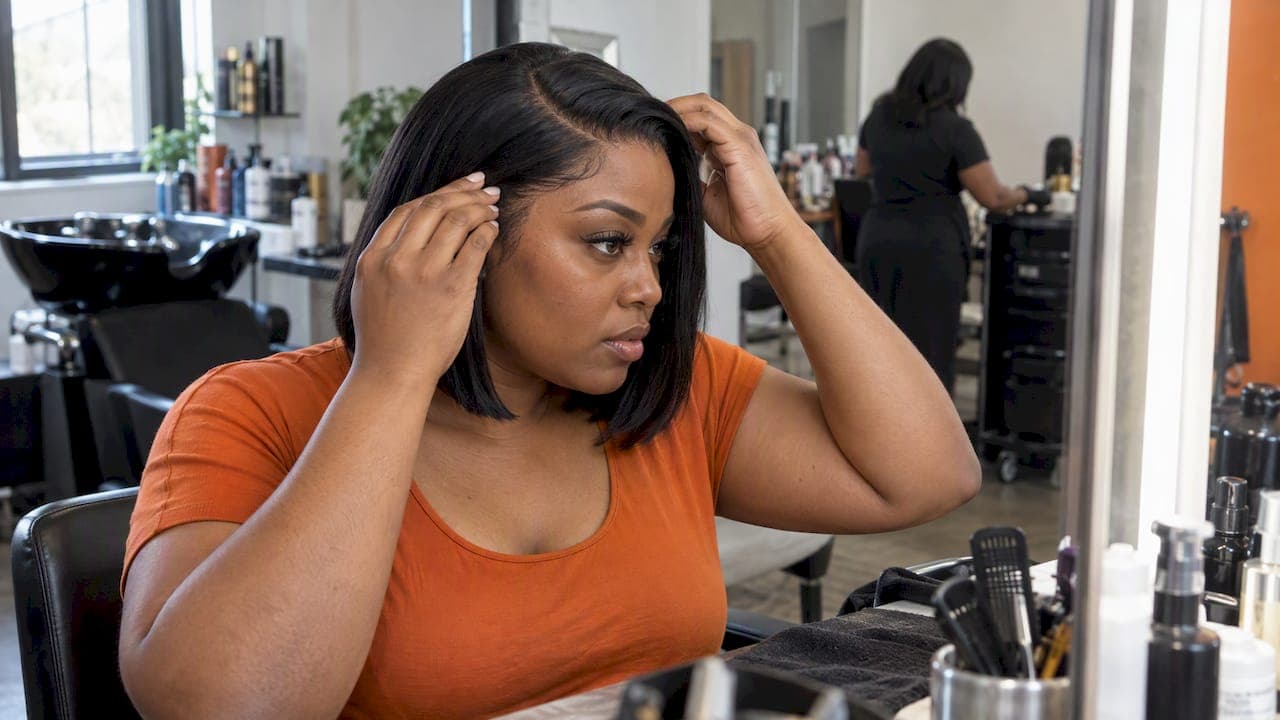
The easiest lace front styles to wear and look natural are side parts, middle parts with face-framing layers, body wave, water wave, half-up half-down looks, buns, and wispy bangs. Each one flatters Black hair when you match it to the right texture and part placement. Below, we walk through a curated gallery, how to pick by face shape, styling and scalp-health steps, and a way to preview every look before you commit.
TL;DR:
- Match the cut to face shape: body waves, deep side parts, and low buns lengthen round faces, while curved bobs soften square jaws.
- Before buying, confirm lace type suits your skin tone, density matches your natural thickness, the hairline follows your natural growth pattern, and the unit supports your intended part.
- Remove the unit every one to two weeks, wash weekly, and avoid installs beyond four weeks, which raise the risk of hair loss from traction.
- Preview part placement, bangs, lace shade, and density on your own photo before spending on a unit or booking an install.
Table of Contents
- 1. A gallery of the best lace front styles right now
- 2. Choosing styles that match your face shape and texture
- 3. How to install, style, and protect your hair underneath
- 4. Previewing these looks before you commit
- 5. Why I believe style and hair health aren't competing priorities
- 6. Try your favorite looks before you buy anything
- FAQ
- Sources
1. A gallery of the best lace front styles right now
We built this gallery around the looks our community asks for most, grouped by finish so you can scan for the texture that matches your vision.
Straight and sleek finishes
A sleek side-part lace flatters nearly every face shape because the deep part creates asymmetry that softens angles. Ask for a silk press finish or a glossy serum to keep flyaways down.
A blunt middle-part bob reads polished and modern. It works best with a slightly thicker density at the crown so the part doesn't look sparse under studio lighting or flash photography.
Body wave and water wave textures
Body wave lace fronts give you movement without the maintenance of tighter curls. They suit rounder faces because the loose S-pattern elongates the silhouette.
Water wave units have a deeper, more defined ripple that photographs beautifully outdoors. Finish with a light curl cream rather than heavy oil so the wave pattern stays crisp instead of clumping.
Curly and coily textures
Kinky curly lace fronts are the closest texture match for many natural hair types, which makes the hairline blend almost disappear. A medium-to-heavy density here hides lace better than a thin one.

Afro-textured coils styled into a rounded shape work beautifully with a middle part and minimal product, letting the curl pattern do the work.
Bob and short styles
A chin-length bob with soft layers suits square and heart-shaped faces by curving inward near the jaw. Pair it with a side-swept bang for extra softness.
A blunt pixie-length cut with a deep side part reads editorial and low-maintenance, ideal for readers who want drama without daily styling.
Updos and half-up looks
A sleek low bun with a center part elongates a round or square face and works for both straight and curly textures.
A half-up half-down style with loose curls framing the face softens strong jawlines while keeping length visible down the back.
Space buns or double top knots bring a playful, youthful finish and work especially well on medium-density units where the part doesn't need to disappear completely.
Bangs and face-framing pieces
Curtain bangs with face-framing layers soften a long or oval face and blend naturally into a lace front when cut slightly longer than you think you need.
Wispy, see-through bangs suit heart-shaped faces by balancing a wider forehead, and they're easiest to maintain on a lighter density cap.
- Side part sleek: flatters most faces; ask for a glossy, low-frizz finish.
- Middle part bob: best with denser crown coverage to avoid a thin-looking part.
- Body wave: elongates round faces; style with a lightweight curl cream.
- Water wave: holds definition outdoors; avoid heavy oils.
- Kinky curly: blends naturally into coily natural hair; choose medium-heavy density.
- Bob with side bang: softens square and heart shapes.
- Low sleek bun: elongates round or square faces, any texture.
- Half-up half-down: softens strong jawlines, keeps length visible.
- Space buns: youthful finish, works well on medium density.
- Curtain bangs: softens long or oval faces, cut slightly longer than expected.
- Wispy bangs: balances a wider forehead, best on lighter density caps.
- Deep side part pixie: editorial and low-maintenance for shorter lengths.
For color and undertone matching across any of these finishes, our guide on wig colors for dark skin walks through how to pick a shade that reads natural in daylight and indoors.
2. Choosing styles that match your face shape and texture
A style only looks effortless when it fits the face underneath it. Start with shape, then layer in texture.
- Oval faces suit nearly everything, but curtain bangs and face-framing layers add dimension without overwhelming balanced proportions.
- Round faces look longer with a deep side part, body wave texture, or a sleek low bun that pulls attention vertically.
- Square faces soften with curved bobs, side-swept bangs, or loose curls that round out strong jaw angles.
- Heart-shaped faces balance well with wispy bangs or half-up styles that widen the lower half visually.
- Long faces benefit from middle parts, blunt bobs, or styles with volume at the sides rather than the crown.
Texture changes how any of these looks behave once installed. Kinky and coily natural hair underneath a unit needs a flatter, low-tension cornrow base so the lace lies smooth without lumps. Curly and wavy natural textures often do better with a leave-out-free install, since blending leave-out against a curlier lace pattern can look patchy. Straighter natural hair usually needs the least prep, just a smooth braid-down or a wig cap to prevent slipping.
Before you order a unit or book an install, confirm these details with your stylist or supplier:
- Lace type: HD, transparent, or Swiss, depending on your skin tone and how invisible you need the hairline.
- Density: light, medium, or heavy, matched to your natural hair's thickness so the part doesn't look artificially sparse or overly full.
- Pre-plucked hairline: confirm it's plucked to mimic your natural growth pattern, not a uniform straight line.
- Recommended part: ask which part placement the unit is cut and layered for, since not every lace is cut for a middle part.
3. How to install, style, and protect your hair underneath
The style only looks good if the hair underneath stays healthy, and that starts with how you install.
Low-tension versus glued installs
A glueless, band-secured install puts less strain on your hairline and edges, and it's easier to remove nightly if you want a break. Glued or taped installs last longer between removals but hold more tension at the perimeter, which is where dermatology guidance becomes relevant. Dermatology guidance notes that wigs and protective styles are popular, and that styles left in place for more than four weeks increase the risk of traction-related hair loss, while removable, low-tension options paired with frequent scalp care reduce that risk.
Daily styling without damage
- Use a low or medium heat setting when restyling body wave or straight units to avoid breaking down the fiber.
- Choose water-based styling creams over heavy pomades for curly and coily textures, since buildup mats the pattern faster.
- Blend baby hairs with a light-hold gel and a soft brush rather than a stiff-bristle edge brush, which pulls at fragile hairline hair.
- Keep your natural edges moisturized underneath the lace, even on days you're not removing the unit.
A maintenance rhythm that protects your scalp
Removing and ventilating your scalp on a consistent schedule, rather than leaving a unit installed for weeks at a stretch, is one of the clearest ways to lower traction risk according to dermatology recommendations on protective styling. A narrative review of Afro-textured hair care recommends washing weekly to ease scalp discomfort and support overall scalp health, which applies whether you're wearing a unit or going without one.
For readers managing thinning edges alongside lace front wear, our piece on low-tension looks for thinning edges covers styles that reduce pull at the hairline while you recover.
Pro Tip: Tint the underside of your lace to your neck or chest undertone rather than your face alone, then apply adhesive in thin layers, letting each one clear before the next, for a cleaner, longer-lasting blend.
If you'd rather buy a ready-made unit in a texture close to your own hair, Da Village Network's human hair wig marketplace lists options from Black-owned vendors across several densities and textures.
4. Previewing these looks before you commit

Scrolling a gallery is one thing. Seeing a style on your own face, in your own lighting, is what actually tells you whether it works.
Our virtual try-on technology lets you upload a photo and preview a look with texture-accurate rendering, so a body wave or kinky curly style shows the way it would actually sit against your features, not a generic model's. You can check part placement, test whether curtain bangs suit your forehead, or confirm a density before you spend money on a unit that doesn't match what you pictured.
- Browse our library of curated styles built specifically for Black hair textures.
- Use your complimentary trial credits to test two looks from this gallery risk-free before deciding. (Check the website for current details on the trial credits.)
- Preview bangs or a deep side part without committing to a cut or an install.
- Check how a tinted lace shade reads against your neck and chest undertone before you buy adhesive or tint.
- Confirm part width and density visually, rather than guessing from a product photo.
Your photos are processed to generate the preview and are never retained or used to train any AI model, so you can experiment freely. For a deeper comparison of frontal types before you try one on, our guide on lace front versus closure units breaks down which option suits different hair goals.
5. Why I believe style and hair health aren't competing priorities
I've spent enough time around lace fronts to know the tension between wanting a dramatic new look and protecting the hair underneath it is real, but it's not a trade-off you have to accept.
A low-tension install and a regular ventilation schedule cost you almost nothing in style payoff. You can still wear the deep side part or the half-up look you've been eyeing. The difference shows up months later, in edges that are still there and a scalp that isn't irritated.
— Christelle
6. Try your favorite looks before you buy anything
We'd rather you see a style on your own face than guess from a photo of someone else. Start with your complimentary trial credits and test a few gallery looks, a body wave, a bang, a bun, before you spend on a unit or a salon visit.
Ready to see which style fits you best? Explore the 1 Week Trial at $17.48 per week or the 4 Week Plan at $38.73 per 4 weeks and preview your next look today.
FAQ
What is the best type of lace frontal?
The best lace type depends on your skin tone and how invisible you need the hairline to read: HD lace suits lighter tones under bright light, while transparent or Swiss lace tends to blend well across a broader range of skin tones. Ask for a pre-plucked hairline matched to your natural growth pattern for the most realistic result.
What are the top-rated lace front wigs?
Top-rated units tend to share three traits: a natural-looking pre-plucked hairline, a density that matches the wearer's natural hair thickness, and a lace type suited to their skin tone. Human hair units in body wave, water wave, or kinky curly textures are consistently popular because they blend well with natural Black hair.
What are the best frontal lace front wigs?
The best frontal units are cut and pre-plucked specifically for the part placement you plan to wear, whether that's a deep side part or a center part. Checking lace type, density, and hairline shape before buying matters more than brand alone.
What are some popular styles of lace front wigs?
Popular styles right now include sleek side parts, body wave and water wave textures, half-up half-down looks, low buns, and curtain bangs. Each one flatters different face shapes and hair textures, which is why trying a look on your own photo before committing helps narrow the choice.
How often should I remove my lace front wig?
Removing and ventilating your scalp every one to two weeks, rather than leaving a unit installed for a month or longer, lowers the risk of traction-related hair loss according to dermatology guidance on protective styling. Pairing that schedule with weekly washing, as recommended in a narrative review of Afro-textured hair care, supports both scalp comfort and hairline health.
Sources
- Hair Care Considerations in Black Women (SBS 2024 — Crystal Aguh, MD)
- Afro-textured hair care: a narrative review and recommendations for dermatologists