
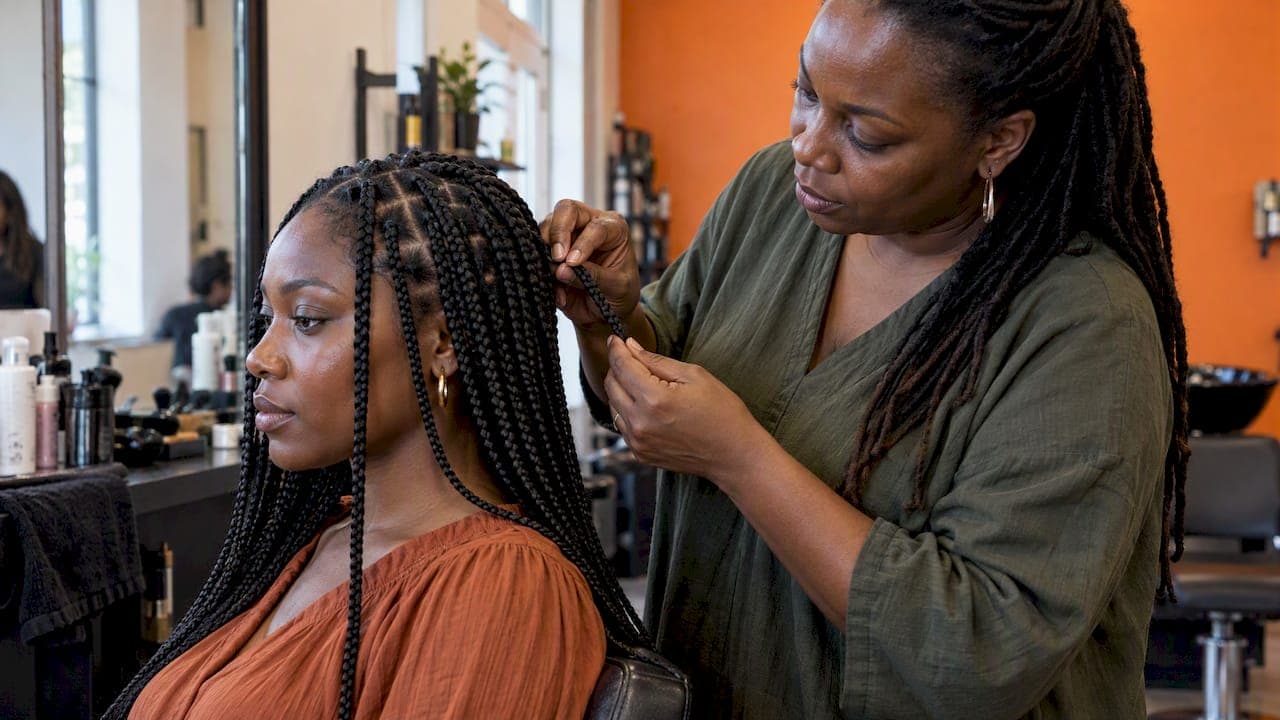
Box braid size is the width of each braid, and it decides almost everything else: how long you sit in the chair, how heavy the style feels, how many ways you can wear it, and how long it lasts. Micro is the thinnest, jumbo is the boldest, and medium is the safest place to start if you have never worn them before.
I have watched people walk into a braid appointment with one photo and walk out with a style that looked nothing like it. Most of the time, the difference was size. So let's break it down, size by size, and then talk about how to preview your pick before anyone touches your hair.
TL;DR
- Sizes run from micro (pencil-thin or smaller) through small, medium, large and jumbo. Medium is about the width of a No. 2 pencil, roughly 10 mm.
- Smaller braids mean more parts, longer installs (7 to 8 hours for small, 5 to 7 for medium) and more styling room. Bigger braids install faster but are heavier per braid and tend to last fewer weeks.
- Weight and tension matter more than looks. Pain or stinging at your hairline is a signal to speak up, not to tough out.
- Not sure? Start with medium, then preview small, medium and large on your own photo before you book.
Table of Contents
- The box braids size chart
- Micro box braids
- Small box braids
- Medium box braids
- Large box braids
- Jumbo box braids
- Small vs medium box braids
- How to choose your size
- Size, weight and your scalp
- Parting patterns change how a size looks
- Care by size
- How long should your hair be for box braids?
- Perspective: why size is the decision worth previewing
- Preview your size before you book
- FAQ
- Sources
The box braids size chart
No official body sets these measurements. Braiders go by feel and by everyday objects, which is why one person's "small" is another's "medium." Here is the commonly used breakdown, with each figure tied to its source.
| Size | Rough width | Typical braid count | Install time | How long it lasts |
|---|---|---|---|---|
| Micro | Tiny, thinner than small | Highest of all | 9 to 12+ hours | Varies by care |
| Small | About half a pencil width | 140 to 250+ | 7 to 8 hours | Up to 2.5 months |
| Medium | About 10 mm, a No. 2 pencil | 90 to 140 | 5 to 7 hours | About 2.5 months |
| Large | About marker-sized | 60 to 90 | 3 to 6 hours | 6 to 8 weeks |
| Jumbo | About two markers together | 40 to 60 | 45 minutes to 3 hours | Up to 6 weeks |
The widths, install times and wear times come from Unruly's guide to box braid sizes. The braid counts come from Eleeji's parting guide. Treat every number as a range. Your hair density, the length of the extensions and your braider's pace will all move it.
One more thing about the chart: it is a starting point for a conversation. Show your braider the object you mean. A pencil, a marker, a photo. Words like "small" and "medium" are slippery.

Micro box braids
Micro braids are the finest size, pencil-thin or smaller. They look almost like a fabric of hair, and they move beautifully when worn loose or swept into an updo.
They also ask the most of you. Expect 9 to 12 hours or more in the chair, according to the Unruly size guide. That is a full day. Plan food, a charged phone and a very good playlist.
Choose micro if you love fine detail, you want maximum styling freedom, and you have the patience for a long sit. Skip it if you are short on time or you know you get restless.
Small box braids
Small braids are about half the width of a pencil. They are the classic "neat and detailed" look, and they hold up well in updos, buns and braided ponytails.
Because there are so many parts, often 140 to 250 or more by Eleeji's count, the weight is spread across the whole head. Each individual braid pulls lightly. The tradeoff is time: 7 to 8 hours for the install, and the style can last up to two and a half months.
Small suits you if you want a polished, versatile look that you plan to keep up for a while. It is also a lovely size for a sleek professional vibe, since the braids lie close and uniform.
Medium box braids
Medium is the size most people picture when they say "box braids." About the width of a No. 2 pencil, they sit right in the middle: not fussy, not chunky.
They install faster than small, around 5 to 7 hours, and last about two and a half months, per Unruly. There are still enough parts, roughly 90 to 140, to keep the scalp easy to clean and moisturize.
If this is your first time, or your first time in a while, medium is the friendliest baseline. You will learn what you like about the weight, the length and the way the braids swing, and you can adjust next time.
Large box braids
Large braids are about marker-sized. They read bold from across the room. The install takes 3 to 6 hours, and they hold for roughly 6 to 8 weeks.
The count drops to around 60 to 90 braids, so each braid carries more hair and more extension weight. That is worth remembering when you choose length. A large braid that goes past your waist is a lot of pull on one root.
Go large when you want a statement look and a shorter appointment, and when you are comfortable refreshing the style sooner.
Jumbo box braids
Jumbo braids are about the size of two markers together. Some installs finish in under an hour, others take up to 3 hours. They typically last up to six weeks.
They are dramatic, quick and low-fuss. They are also the heaviest per braid, with only about 40 to 60 sections on a whole head. If your hairline is delicate or you are recovering from a style that was too tight, jumbo deserves a careful conversation with your braider about length and tension.
Small vs medium box braids
This is the choice most readers are really weighing, so here it is side by side.
| Small | Medium | |
|---|---|---|
| Look | Fine, detailed, sleek | Balanced, classic |
| Braids on your head | About 140 to 250+ | About 90 to 140 |
| Time in the chair | 7 to 8 hours | 5 to 7 hours |
| Wear time | Up to 2.5 months | About 2.5 months |
| Updos | Excellent | Good |
| Best for | Polished, long-term wear | First-timers, everyday ease |
Small gives you more updo freedom and a neater finish. Medium gives you back a couple of hours and a style that is easy to read as "box braids" in any photo. Both can last a similar stretch when cared for well.
My honest rule: if you will wear your hair up most days, go small. If you want to wear it down, swing it and not think about it, go medium.
How to choose your size
A few questions narrow it down fast.
How much time can you give? Be honest. A 9-hour micro install that you dread is worse than a 4-hour large one you enjoy.
What does your hair density allow? Thinner or fine hair at the edges may not carry heavy braids comfortably. A braider who knows your head will tell you what the roots can handle.
How do you want to style it? Updos, buns and ponytails favor small and medium. Statement looks favor large and jumbo.
How long will you keep it? Smaller sizes tend to go the distance. Larger ones often look their best for 6 to 8 weeks, then start to loosen at the root.
What is your budget? More braids usually means more hours, and more hours usually means a higher quote. Our breakdown of box braids cost and hair pack counts shows how the number of packs can shift your price.
Size, weight and your scalp
Here is the part that gets skipped in chart posts. Bigger is not automatically gentler, and smaller is not automatically safer. What matters is tension and weight.
The American Academy of Dermatology suggests thicker braids and avoiding methods that pull hard, as summarized by a science radio segment on traction alopecia. The same piece notes that pain from a tight style is a sign to change it. Separately, a dermatology practice blog notes that soreness, pain or stinging along the hairline during or after installation are early markers of too much tension, and that longer wear and heavier extensions add to the pull on the follicle.
Put those together and you get practical rules:
- Tell your braider the moment something pinches. Do not wait for the end.
- Keep extension length reasonable with larger sizes, since each braid carries more weight.
- Ask for even, consistent parts. Professional braiders take time to make equal-sized sections, and good parting evens out braid size and reduces unnecessary tension.
- Do not stretch a style far past its window just because it still looks fine.
- If you have noticed thinning, tenderness or bumps along your edges, see a board-certified dermatologist before your next install.
If edge protection is your main worry, our guide to knotless vs box braids walks through how each technique feels on the hairline.
Parting patterns change how a size looks
Two heads of medium braids can look quite different depending on the parts. The square pattern is easier to measure and faster to install. The bricklayer pattern staggers rows for fuller scalp coverage and a more natural look. Diamond or triangle parts get creative. All three are described in Eleeji's parting guide.

Doing them yourself? Gyal Braids suggests working in quadrants with a rat-tail comb so the sections stay clean and consistent across your whole head. Even so, a first install is a good one to leave to a pro.
Care by size
Size changes how often you will think about your scalp. Larger parts show more scalp between braids, which makes it easy to moisturize but also easy to see tension. Smaller parts hide the scalp and ask for a bit more intention.
A simple routine works at every size: light oil on the scalp, a satin bonnet or scarf at night, and a gentle scalp cleanse every two to three weeks, as laid out by Nakuru Locks and Braiding. For oils, plant-based scalp oil tips for braids cover how often to apply and what to reach for.
Cotton is the quiet enemy. Experts quoted by Capital Lifestyle Magazine point to friction from cotton surfaces as a main cause of matting and frizz in added hair. Our guide on sleeping with braids covers the nighttime setup in detail.
How long should your hair be for box braids?
Most braiders want enough length to grip and hold the braid at the root, and many say a couple of inches is workable. That varies by braider and by size. Smaller braids need a bit more to anchor, since there is less hair per braid. Ask during your consultation rather than guessing, and bring a photo of your hair as it is now.
Perspective: why size is the decision worth previewing
We built Stylemycrown because choosing a braid size should not be a gamble. Words like "small" and "medium" mean something different to every braider, and a photo from the internet rarely shows your face shape, your hairline or your length.
So we put the guesswork on your screen. Our catalog holds over 528 styles curated for Black and textured hair, and you can try them on your own photo with augmented reality. Put small box braids next to medium, then large. Watch how the part lines frame your face. Notice whether the jumbo look feels like you or like a costume.
The point is not to pick for you. It is to walk into the chair with a clear picture, a specific size, and the confidence to say exactly what you want. That conversation goes better for everyone, you and your braider both. Our face data is processed securely and is never retained or used for AI training, because trying on a style should never cost you your privacy.
— Christelle
Preview your size before you book
If you are torn between small and medium, or curious whether jumbo suits your face, try them first. Stylemycrown lets you test braid sizes on your own photo, and new users start with 2 complimentary credits.
When you are ready for more, the plans on our pricing page start with a 1 Week Trial at $17.48 per week, or a 4 Week Plan at $38.73 per 4 weeks. You can also start from the virtual try-on for Black hair on our homepage. For ideas on which looks are kind to your edges, see our picks for scalp-safe box braid styles.
FAQ
Are smaller or larger braids better for hair?
Neither wins outright. Smaller braids spread weight across more roots but take longer and can feel tight if parted too fine. Larger braids install faster but carry more weight per braid. Whatever size you pick, pain along the hairline means the tension is too high.
How much do jumbo box braids typically cost?
Jumbo usually costs less than small or medium because the install is shorter and there are fewer braids, but prices vary by braider, city and hair length. Ask for a quote that includes the hair. Our box braids cost guide explains how hair packs affect the total.
Is 3 months too long for box braids?
It is usually longer than recommended. Small and medium braids are described as lasting up to about two and a half months, and larger sizes closer to six to eight weeks. Longer wear and added weight increase pull on the follicle, so take them down on schedule.
What size should I get if I have never had box braids?
Medium is the easiest baseline. It is quicker than small, versatile, and gives you enough parts to keep your scalp clean. After a few weeks you will know whether you want to go smaller or larger next time.
How are knotless braid sizes different from box braid sizes?
The size names are the same, since they describe braid width. The difference is how the braid starts at the root. For a full comparison, read our guide on braids vs twists or the knotless breakdown above.
Sources
- The Complete Guide to Box Braid Sizes, Unruly
- Knotless Braids Parting Guide, Eleeji
- Do Protective Hairstyles Cause Hair Loss?, Aglow Dermatology
- Some hairstyles can lead to traction alopecia, A Moment of Science
- How to Do Box Braids at Home, Gyal Braids
- Box Braids Hairstyles 2026, Nakuru Locks and Braiding
- Step-by-Step Guide to Stunning Boho Braid Styles, Capital Lifestyle Magazine