
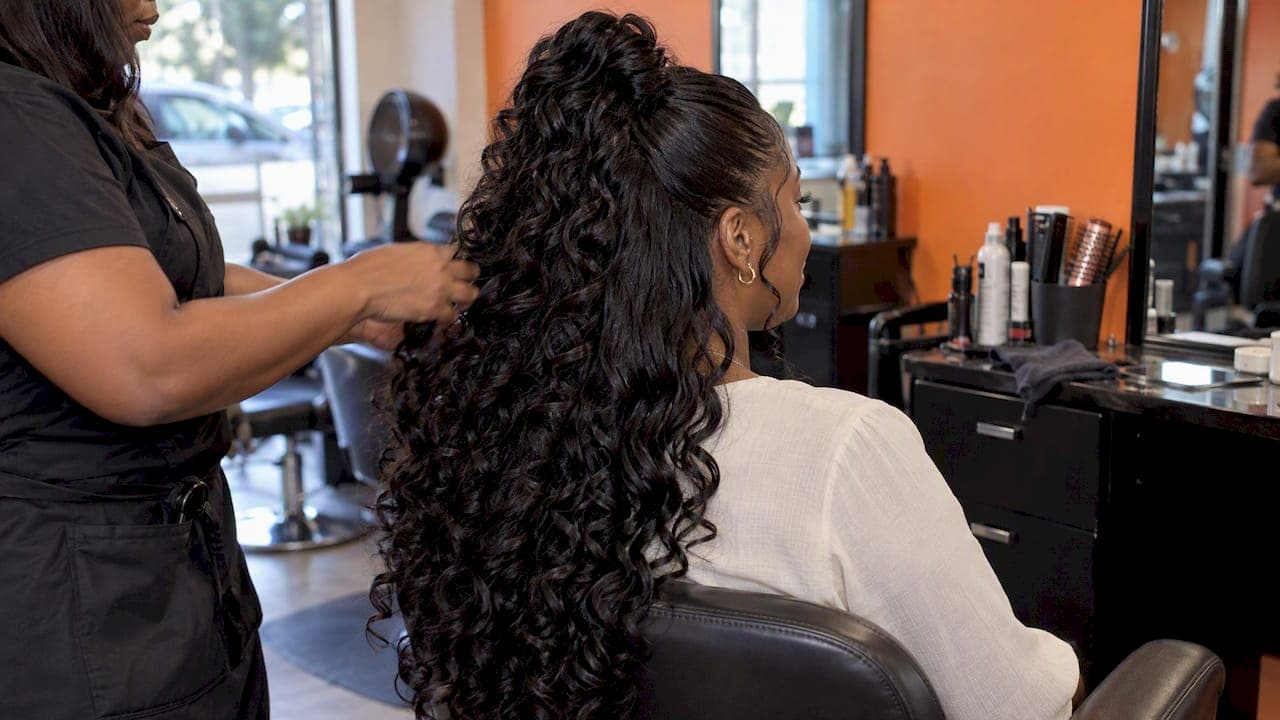
A half up half down sew in gives you a lifted ponytail, bun or top knot on top and flowing hair underneath, with a braided foundation hidden below. You can get it with a leave-out, without one, or as a quick weave. Each route changes the price, the tension on your scalp and how natural it looks. This guide walks through all three, the styles worth screenshotting, what US salons list for the service, and how to protect your own hair while you wear it.
TL;DR
- A half up half down sew in is a partial install: the upper section is styled up, the lower section is sewn hair worn down.
- The three main routes are a leave-out install, a flip-over method with no leave-out, and a quick weave. Sew-in methods lean on braids and thread. Quick weave leans on glue or a cap.
- US salon listings we found run from $110 to $265+ for labor, and hair is usually extra. Plan on at least 3 bundles unless your stylist says otherwise.
- Plan to take it down after 6 to 8 weeks, and treat any pain or bumps at the base of the braids as a signal to loosen up.
- You can preview the look on your own photo with our virtual try-on before you buy hair or book a chair.
Table of Contents
- What a half up half down sew in really is
- Three ways to get the look
- Half up half down sew in styles worth bringing to your stylist
- See it on your own face before you buy hair
- How the install is done and how the leave-out blends
- Wearing it on natural hair: protect the leave-out
- How many bundles you need
- What it costs
- Our perspective
- Care, wear time and when to take it down
- FAQ
- Sources
What a half up half down sew in really is
I remember sitting in a chair for hours, only to see the finished look in the mirror and think, that is not what I pictured. A half up half down sew in is one of those styles where the picture in your head and the result can drift apart quickly. Part of the reason is that the name covers several different installs.
The common thread is simple. Hair Extensions Inc. describes the appeal as pairing a high ponytail or updo with curls, sleek straight hair or another flowing style, while the partial install leaves some natural hair out for blending. The top is where the drama lives. The bottom is where your braids and tracks hide.
If you want to understand the full-head alternatives first, our guide to half up, half down Black hair covers styles and care beyond sew-ins.
Three ways to get the look
Most people searching this want to know which version to ask for. Here is how the options stack up.
| Method | How it works | Best for | Watch out for |
|---|---|---|---|
| Leave-out sew in | Braided base, wefts sewn on, a section of your hair left out and heat styled to blend | A natural blend at the part and hairline | Daily heat on the leave-out, and matching texture takes skill |
| Flip-over (no leave-out) | Hair is installed so the top section flips over the tracks, with no natural hair left out | Curly or textured looks where heat is a worry | Needs a stylist who has done it before |
| Quick weave | Back portion is bonded or applied with a cap, the top is pulled into a ponytail or bun | Short-term wear and a lower labor price | Glue and edge tension, and it does not last as long |
Let me say a little more about each.
The leave-out version
This is the classic. Kelley Tresses explains that the hair is sectioned horizontally to create a cornrow base, wefts are sewn onto the braids, and the leave-out is then styled with a flat iron or wand so it melts into the extension hair. It looks the most seamless when your texture and the bundle texture are close, or when you are comfortable using heat.

The flip-over method with no leave-out
If you would rather skip heat, the flip-over technique is worth a look. One popular
shows a flip-over sew in with no leave-out and no glue, using curly human hair that blends with the top section. The idea is that the upper hair falls over the tracks, so nothing of your own needs to be straightened to match.The quick weave version
A quick weave is a faster, shorter-term cousin. Ula Hair describes it as sectioning your hair into two parts and pulling the upper section of real hair into a ponytail or bun. The trade-off is the bonding method. We break down the tension and glue question in our comparison of sew in vs quick weave for Black hair, and it is worth reading before you decide, especially if your edges are fragile.
Half up half down sew in styles worth bringing to your stylist
You do not need a hundred options. You need a handful of clear looks, and a photo for each. These are the ones that come up most.
Curly with a golden wrap
True Glory Hair shows a curly half-up, half-down weave where the raised section is wrapped with golden thread, and recommends generous mousse to keep the curls defined. It reads as dressed up without being fussy.
High half ponytail
The same post describes a high half-ponytail wrapped with a small section of weave hair. It is a clean option when you want a lifted crown and curls falling from the back. The article says the tracks stay hidden, especially with thicker, longer natural hair.
Top knot with split bangs
This one adds a face-framing element. According to True Glory Hair, the look uses a top knot with split bangs and can last up to 8 weeks. Bangs add a custom cut, so bring a clear reference photo.
Pin-up bun and side sweep
A roundup from HairstylesFeed describes a neatly coiled high bun with smooth swept bangs as polished and vintage-inspired. Pair it with sleek straight lengths for a formal feel.
Deep side part with flipped ends
The same roundup describes a deep side part with outward-flipped lengths for a Barbie-like finish. It is a good everyday option if you like pressed hair with movement.
Mid-length bun or crown top knot
Elfin Hair names ponytails, box braids, buns and twists as half-up choices. A mid-length bun between the ears looks romantic and sweet, and a crown top knot looks cool. Braids on top are a nice choice if you want the upper section to double as a protective style. See our notes on low tension braided ponytails for ideas on how to keep that top section gentle.
For more shapes to borrow for the top half, our list of natural updo hairstyles covers texture and length.
See it on your own face before you buy hair
Here is the honest problem. Hair is a real purchase. Bundles, labor and time in the chair add up, and a style that looks perfect on a model can sit differently on your face shape, hairline and skin tone.
That is why we built Stylemycrown. It is an augmented reality try-on made for Black and textured hair, with more than 528 styles in the catalog. You upload your photo, pick a look, and see it on you. New users get 2 complimentary credits, so you can test a high half ponytail, a top knot and a side-swept bun without committing to any of them.
If you want to keep trying after your free credits, paid plans are on our pricing page: the 1 Week Trial is $17.48 per week and the 4 Week Plan is $38.73 per 4 weeks. You can start with the virtual try-on itself, no chair required.
One more thing we care about: face data is processed securely and is never retained or used for AI training. Your photo is yours.
If your edges are thin or sensitive, run the same test on low tension looks first. Our guide to styles for thinning edges is a good companion.
How the install is done and how the leave-out blends
Knowing the steps helps you spot a rushed job. Based on what Kelley Tresses outlines, installs typically go like this:
- Start with clean, detangled hair as the base.
- Part the hair horizontally from ear to ear.
- Leave small sections out around the hairline and the part to conceal tracks.
- Braid the lower section into a cornrow foundation.
- Sew wefts onto the braids.
- Style the leave-out with heat so it blends with the extension hair.
The True Glory Hair top knot style lists a similar flow: braiding and netting the lower half, sewing bundles from the bottom upward, hot-combing the top, then creating the bun and wrapping it with weave hair.
Blending in small sections
The difference between a good blend and an obvious one is patience. One guide on blending natural hair with wefts suggests working in small sections and aligning lengths and textures. If your stylist grabs a huge chunk of leave-out and flat irons it once, ask them to slow down.

Color matters too
A blend fails fast when the shade is off. Before you buy, read this guide on color matching extensions and bring both a daylight photo and a swatch of your own hair to the appointment. Lighting in a salon can be misleading.
Wearing it on natural hair: protect the leave-out
This part gets skipped, and it is the one I wish more people talked about. Your leave-out is the hair that does the most work. It takes the heat, the friction and the daily styling.
Kelley Tresses advises washing, conditioning, detangling and blow-drying your natural hair before the install, and leaving hair around the hairline and part unbraided to conceal the wefts. Here is how I would put that into practice:
- Use heat sparingly. Use a heat protectant and the lowest setting that gets the job done. If you want to avoid heat altogether, ask about the flip-over method above.
- Match texture honestly. If your coils are tight and your bundles are bone straight, the leave-out will fight you every morning. Choose a texture you can live with, or a curl pattern that blends with your hair.
- Keep the leave-out moisturized. Regular moisturizing of your natural hair is part of the standard care advice from Kelley Tresses.
- Think about the hairline. If you are mid big chop or transitioning, the leave-out may be short. Say so at your consult, and ask about a closure or a different style.
For a longer comparison of how different installs treat the hairline, read our piece on how sew ins compare to quick weaves for edges.
How many bundles you need
There is no universal number. It depends on length, fullness and how much of your head the sewn section covers. Some real examples from US salons:
- GoldyKi Beauty & Hair in Culver City requires a minimum of 3 bundles for its half up half down sew in.
- Smoked by Shea lists its Half Up-Half Down as hair not included, and specifies either two packs of Empire hair or four packs of Organique hair, plus a black wig cap. Its V-Part version asks for two packs of 100% human hair, preferably 12 or 14 inch.
The lesson: brands package hair differently, so a "pack" from one line is not a "bundle" from another. Ask your stylist for the exact product and count before you shop, or ask her to supply the hair.
Things that push the number up: longer lengths, a denser or curlier texture, extra volume in the ponytail or bun, and adding bangs or a wrapped top knot.
What it costs
Prices vary by city and by stylist, and most listings leave out hair. These are real listings from US booking pages, so use them as a range rather than a quote.
| Salon | Service | Listed price | Time | Notes |
|---|---|---|---|---|
| Smoked by Shea | Half Up-Half Down | $110 | 120 min | $15 deposit, hair not included |
| Smoked by Shea | V-Part Half Up Half Down | $125 | 120 min | $15 deposit, 2 packs human hair |
| Curly 2 Straight | Half Up Half Down | $140 | 3 hours | Page does not say if hair is included |
| Uriela's Hair | Sewing Half Up, Half Down | $150 | 2 hours 40 min | Hair not included, clean detangled hair required |
| Folliquul | Half up/half down | Starting at $200 | 2 hours 15 min | Back may be sewn or quick-weaved, with or without heat |
| GoldyKi | Half up half down sew in | $265+ | Hair excluded, curls, crimps, waves or layers $45 each |
Two things to notice. First, the spread is large, from $110 to $265 and up, so shop by what is included, not by the headline number. Second, add-ons matter. GoldyKi charges $45 each for curls, crimps, waves or layers, and Uriela's notes that additional styling may cost extra.
Add the hair on top. Ask your stylist for a total estimate that covers labor, hair, deposit and any styling add-ons. If you are curious about how a traditional full sew in is priced, Curly 2 Straight lists "From" prices of $195 for a traditional sew in and $230 for a closure sew in on its booking page, which gives you a sense of how the half-up version compares.
Our perspective
We built Stylemycrown because the hardest moment in any protective style is the one before you sit down. You are about to spend money, hours and trust. You are hoping the stylist sees what you see.
We believe a half up half down sew in works best when three things are true. The look suits your face and your lifestyle. The method suits your hair, not just the trend. And you walk in with a photo, not a vague description.
That last part is why we made the catalog broad. With more than 528 styles curated for different textures and types, you can compare a high half ponytail with a top knot, then show your stylist exactly what you want. It cuts down the consultation, which helps stylists too.
We also think the conversation about tension is not optional. A style that looks gorgeous for a week and costs you your edges is not a good deal. If you want a deeper look, our guide on stage aware locs maintenance and traction alopecia shows how we think about scalp safety across styles.
Take your time. Try the look first. Then book the chair.
— Christelle
Care, wear time and when to take it down
A half up half down sew in is a commitment, so treat it like one.
Sleep. Wrap your hair at night with a silk or satin scarf, as Kelley Tresses recommends. It reduces friction on the leave-out and keeps the top section neat.

Wash. Sew-ins do not remove the need for cleansing. Allure notes that scalp care remains vital and that washing should be done carefully so you do not disrupt the braids.
Time limit. The same Allure piece says sew-ins should generally come out after 6 to 8 weeks, depending on how fast your hair grows, to prevent matting and protect your natural hair. Mark the date on your calendar when you book.
Tension. Allure's protective styles guide warns that excessive tension from heavy extensions or tight braiding can cause traction alopecia, inflamed follicles and permanent damage. In that article, board-certified dermatologist Dr. Downie says pain or small bumps at the base of braids are critical signs of tension that can lead to permanent damage. If you feel that, go back to your stylist and ask to have the braids loosened. If bumps or soreness continue, see a dermatologist.
Do not forget the scalp. Another Allure feature makes the point that protective styling does not mean tucking hair away and forgetting it. Moisturize and cleanse your scalp if you can.
FAQ
How many bundles do you need for a half up half down sew in?
Most salons we reviewed start at around 2 to 4 packs or bundles, depending on the brand and length. GoldyKi requires a minimum of 3 bundles, while Smoked by Shea lists two packs of Empire hair or four packs of Organique. Ask your stylist for the exact count for your length and texture.
How much does a half up half down sew in cost?
Listed labor prices on US booking pages we checked range from $110 to $265+, and hair is usually not included. Add-ons like curls or layers can cost extra. Ask for a full estimate before you book.
Can I do a half up half down sew in on natural hair?
Yes. Your own hair is braided down in the lower section, and the upper section is either left out or styled into a ponytail or bun. Start with clean, detangled hair, keep up moisture, and ask your stylist about a no-heat flip-over method if you want to avoid straightening your leave-out.
How long does a half up half down sew in last?
Plan on 6 to 8 weeks at most. True Glory Hair says a top knot version can last up to 8 weeks, and Allure says sew-ins should generally come out in that window to prevent matting. Your hair growth rate and care routine will affect the timing.
Sources
- Half-Up Half-Down Sew-In, Kelley Tresses
- 5 Ways To Style Half Up Half Down Sew In, True Glory Hair
- How To Half Up Half Down Quick Weave, Ula Hair
- Types of Sew Ins, Hair Extensions Inc.
- 5 Easy Half Up Half Down Quick Weave Styles, Elfin Hair
- Half-Up Half-Down Sew-In Styles, HairstylesFeed
- Half-Up Half-Down Sew-In blending guide
- How to Color Match Extensions to Your Hair
- GoldyKi Beauty & Hair, Culver City
- Smoked by Shea services
- Curly 2 Straight services
- Uriela's Hair, Portland
- Folliquul booking page
- Hair Extension Care Tips, Allure
- Protective Styles for Natural Hair, Allure
- Natural hair growth tips, Allure