
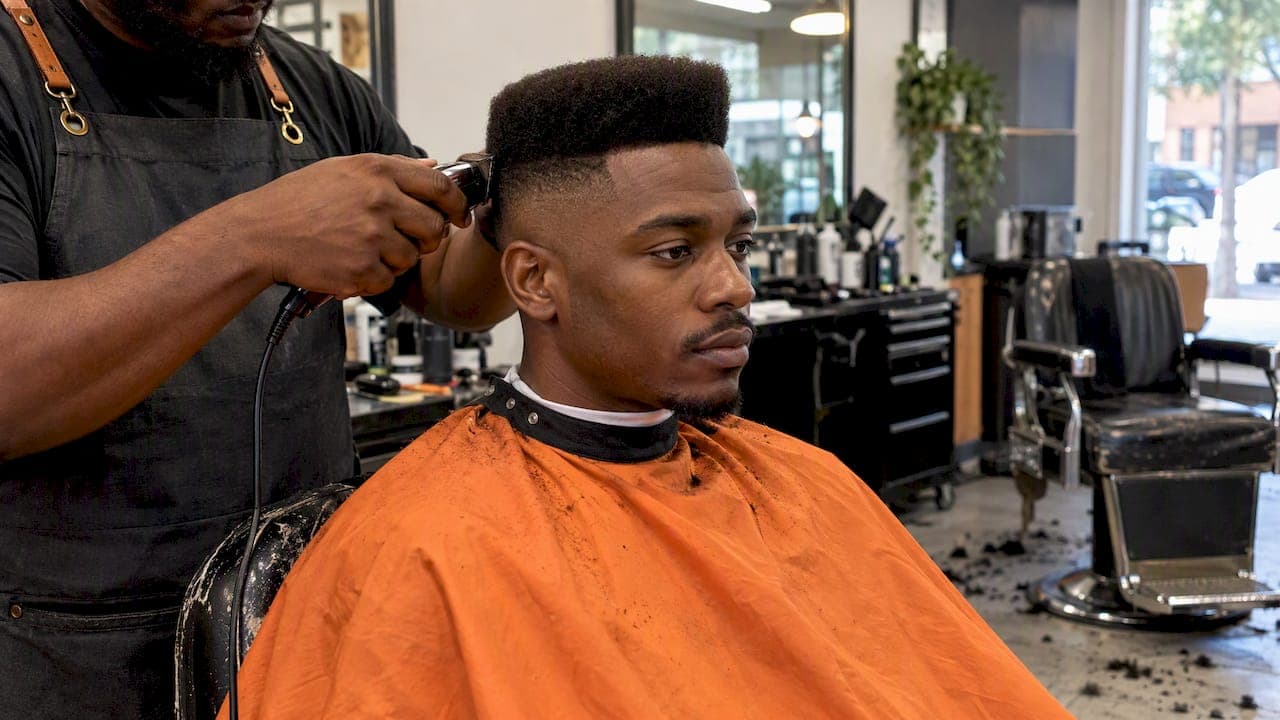
The best high top fade is the one that fits your texture, your top length, your face shape and how often you are willing to sit in a barber's chair. For most people with 3c to 4c coils, that means a classic boxed top on a high fade or a taper fade high top. If you want something softer, a shadow fade is the safer call.
I have watched people walk out of a shop with a cut they loved on the poster and barely recognized in the mirror. The fix is not a better barber alone. It is knowing what you are asking for before the clippers come out.
Below, six versions side by side, what each one asks of your hair, and how to preview the result first.
TL;DR
- A high top fade pairs tight sides with a long, shaped top. It works best on type 3c to 4c hair with at least 3 to 4 inches on top.
- The fade should start above the temples. Tell your barber exactly where it stops and what the base is: skin, shadow or stubble.
- Expect to budget for a trim every 1 to 2 weeks if you want the lines crisp. U.S. salon prices average $45 to $90 a session.
- Fine or thin hair does better with a shadow fade than a high skin fade.
- Preview the cut on your own photo before you commit. Our try-on gives you 2 complimentary credits to start.
Table of Contents
- What makes a high top fade a high top fade
- Does your hair work for it?
- Six high top fade versions compared
- High fade, mid fade, low fade: which height?
- Face shape: the mistake barbers see most
- What it really costs and how long it lasts
- How to talk to your barber
- Our point of view
- Preview your high top fade before the cut
- How to choose: a quick decision guide
- FAQ
- Sources
What makes a high top fade a high top fade
The sides and back are faded down tight. The hair on top stays long and gets shaped into a flat, squared-off box. There is nothing subtle about it, and that is the point.
Two details separate a good one from a mediocre one.
First, the fade has to start high. If it starts at the ear instead of above the temples, the silhouette collapses into something closer to a generic short cut. A true high fade begins at or above the temples, typically two to three inches above the ear, and drops sharply to very short or bare skin.
Second, the top needs structure. That comes from texture and length, which we get to next.
A little history worth knowing
This cut is a piece of culture, not just a trend. It is tied to the hip-hop golden age, roughly 1984 to 1993. Christopher Reid of Kid 'n Play is widely associated with one of the most extreme versions), a towering vertical top that defined the era's look. When you sit down for a high top today, you are wearing that lineage. A precision cut just makes it cleaner.
Does your hair work for it?
Texture decides more than any trend does.
The high top fade does best on natural 3c to 4c hair, because those coils have the strength to stand upright. Length matters too. You want at least 3 to 4 inches on top for a basic shape. Dramatic, iconic heights usually need 6 inches or more.
Straighter hair types struggle to hold the box without a lot of product or styling help. If that is you, a high fade with a textured crop or quiff is a better match than a true flat top.
If you are not sure how your coils will behave once they are cut into a shape, this curly cut and style guide from a Dubai salon explains how curl pattern and length affect the finished result. Read it alongside our own breakdowns of 4C hairstyles and styles for 4B hair.
Growing out from a big chop? You do not need six inches on day one. Hair grows about half an inch a month, so a basic top is a realistic goal within a few months of growth. Our guide to short natural hairstyles covers the stages in between.
Six high top fade versions compared
Here is how the main options stack up. Heights and upkeep notes come from the sources linked in this article. Where a source does not give a number, I describe the effort in plain terms instead.
| Version | Best for | Top length | Upkeep | Difficulty for the barber |
|---|---|---|---|---|
| Classic boxed high top | 3c to 4c, strong coils | 3 to 4 inches minimum, 6+ for drama | Highest: lines fade fast | High |
| Taper fade 4c high top | 4c hair, conservative workplaces | Moderate | Lower: narrows only at neckline and temples | Medium |
| High skin fade high top | Dense hair, maximum contrast | Moderate to long | Highest | High |
| Shadow fade high top | Fine or lower density hair | Moderate to long | Moderate | Medium |
| Undercut high top combo | People who want a sharp disconnect | Long | High | High |
| High fade with braids or locs | Braided or loc styles | Varies | Varies with the style | Medium to high |
1. The classic boxed high top
This is the original. Flat top, square corners, tight faded sides. It looks best on dense 4c hair with enough length to stand on its own.
The tradeoff is time. The fade loses its precision in 7 to 10 days, so the cut looks its sharpest in the first week. If you love a crisp line, this is your cut. If you want to forget about your hair for a month, it is not.
2. The taper fade 4c high top
The Taper Fade 4c High Top narrows only at the neckline and temples, so the sides keep some length. It is the gentlest route into the style.
Barbers will tell you a taper and a fade are not the same thing. A taper gradually shortens hair at the sideburns and neckline while leaving length elsewhere, and a fade is a more aggressive blend that removes weight from the sides. If you want the safe middle, say "taper fade" and name the length at the base.

We go deeper on this in our curly taper fade guide, which includes barber phrases you can screenshot.
3. The high skin fade high top
Maximum contrast. The sides go down to bare skin, and the top looks even taller by comparison. It is striking on dense hair.
It is also unforgiving. If you have fine or low-density hair, a high skin fade can expose too much scalp and make your hair look thinner than it is. Skin fades also need touch-ups more often, so factor that into your budget.
4. The shadow fade high top
A shadow fade leaves a slight dark cast instead of bare skin. It is a safer, more flattering choice for fine hair, or for anyone who wants softer contrast. It also grows out more gracefully, which matters if you cannot get to the shop weekly.
5. The undercut high top combo
Here the sides are cut away sharply, with a visible break between the sides and the top. The look is bold and graphic. This combination is one of the looks listed for 4c texture in a 2026 style guide.
Because there is no gradual blend to hide growth, the line between the sections shows quickly. Plan on frequent visits.
6. The high fade with braids or locs
Some people keep the fade and swap the box for braids, twists or dreads. A barber guide notes that a true high fade with dreads starts near the parietal ridge, about two fingers above the temple. Any lower and it becomes a mid fade, whatever the barber calls it.
There is also a high fade braided crown variation if you want the fade with something more sculptural on top.
High fade, mid fade, low fade: which height?
This question comes up constantly, so here is the short version.
- High fade: starts at or above the temples. The most dramatic, high-contrast option.
- Mid fade: starts around the midpoint between the temple and the ear. More balanced.
- Low fade: begins closer to the ear and neckline. More conservative, and it needs touch-ups about every 3 to 4 weeks rather than every 1 to 2.
A high top does not strictly need a high fade, but the combination is what gives the look its lift. A mid fade with a tall top can look great on a softer, more everyday cut. Just know that it reads as a different style.
Face shape: the mistake barbers see most
According to professional barbers, the most common pitfall is ignoring face shape when choosing fade placement.
Round face: a high fade with vertical lift draws the eye upward and elongates the profile. Our post on round face hairstyles for Black hair shows how much height changes the picture.
Heart or diamond face: go softer. A taper rather than an aggressive skin fade helps keep a narrow chin from looking pointed or the forehead from looking too wide.
The high fade also helps elongate round or square faces, so if that describes you, you are in good shape.
What it really costs and how long it lasts
Here is the realistic picture for a salon visit, based on a 2026 guide.
| Item | Typical range |
|---|---|
| Cost per session | $45 to $90 |
| Tip | 18 to 22% |
| Appointment length | 30 to 45 minutes |
| Recommended visit frequency | Every 1 to 2 weeks |
Do the math before you commit. At $45 to $90 a visit every two weeks, you are looking at roughly $90 to $180 a month before tips. That is real money. Many people stretch visits to three weeks and accept a softer line.
You can extend things at home. Barbers recommend a cordless zero-gap trimmer for weekly touch-ups at the neckline and temple edges, which can buy you an extra 7 to 10 days between professional visits. Go slowly, trim only the edges, and leave the fade itself to your barber.
If you are losing hair at the hairline and wondering how a high fade will sit, some men look at scalp micropigmentation to create a defined, shaved-head look. This article on low hairline SMP and touch-up timelines is a useful read before you decide. Talk to a licensed practitioner, and if the thinning is sudden, see a dermatologist first.
How to talk to your barber
Most bad fades come from a vague request, not a bad barber. Many people ask for a high fade without saying where it should stop, and end up with a disconnected look and too much scalp showing.
Try this script:
- "I want a high top. I have about [your length] on top and want a flat, squared shape."
- "Start the fade at the temple line, and blend it up into the top, not a hard line." (Or ask for the hard line if you want the undercut.)
- "Take the base down to [skin, shadow or stubble]." This matters because you need to name the length at the base or risk a cut that is too aggressive or too subtle.
- "Clean up the neckline and edges, but do not go back with the line." Protect your hairline. Our guide to protecting your edges explains why this matters over time.
Bring two or three photos. Not one. A single photo can mislead because lighting, hair density and head shape differ from yours.
Our point of view
We built Stylemycrown because we kept hearing the same story. Someone finds a cut they love online, takes the photo to the shop, and the result does not match. Not because anyone did a bad job. Because the photo was never on their head.
Most style tools were not made with Black hair in mind. Texture gets flattened, volume gets shrunk, and a high top ends up looking like a smooth wave. That is why we focus on Black and textured hair, with a catalog of over 528 styles, so you can see how a shape sits on your own face before you spend two hours and $90 on it.

Our view on the high top fade is simple. It is one of the most expressive cuts out there, and it deserves a plan. Know your texture. Know your length. Know your face shape. Then pick the version that fits your life, not just the one that looks best on someone else.
You should also be able to keep your privacy. Face data is processed securely and is never retained or used for AI training. Your face is not our product.
— Christelle
Preview your high top fade before the cut
Stylemycrown is our virtual try-on built for Black and textured hair. Upload a photo, browse 528+ styles and see how a boxed top, a taper or a shadow fade looks on you. You start with 2 complimentary credits, so you can test a few shapes without paying.
When you are ready for more, the 1 Week Trial is $17.48 per week, and the 4 Week Plan is $38.73 per 4 weeks. Compare that with the cost of one cut you end up not loving. You can also start on the try-on page and see for yourself.
Barbers and stylists can use the catalog in consultations too, so the conversation starts with a picture, not a guess.
How to choose: a quick decision guide
- You have 4c hair, 4+ inches on top and want max impact: classic boxed high top.
- You want the look without the weekly upkeep: taper fade high top.
- You have dense hair and love sharp contrast: high skin fade high top.
- Your hair is fine or you are thinning at the sides: shadow fade high top.
- You wear braids, twists or locs: high fade with a braided or loc top.
- You are in the middle of growing out: wait for the 3 to 4 inch mark, then preview the cut first.
The common thread is that the cut should serve your hair, not fight it. If you are choosing between several, preview two or three and compare them side by side.
FAQ
What is the best looking fade?
There is no single answer, because it depends on face shape and hair density. A high fade is the most dramatic and tends to flatter round and square faces. A shadow or taper fade is often the better choice for fine hair or a heart-shaped face.
What is the difference between a mid fade and a high fade?
A high fade starts at or above the temples and gives the most contrast. A mid fade starts around the midpoint between the temple and the ear, so it looks more balanced. A low fade starts near the ear and neckline and is the most conservative.
What is better, a high taper or a low taper?
A high taper gives more definition and more contrast, but it needs more frequent upkeep. A low taper is subtler and lasts longer between cuts, roughly 3 to 4 weeks for low fades. Choose based on your workplace, your hair density and your schedule.
How long should my hair be for a high top fade?
Aim for at least 3 to 4 inches on top for a basic shape. For a dramatic, tall box, 6 inches or more is typical. Type 3c to 4c coils hold the shape best.
How often do I need a trim?
For crisp lines, plan on a visit every 1 to 2 weeks. A home trimmer for the neckline and temple edges can stretch that by about a week.
Sources
- High Top Fade: How-To, Photos and Pro Tips, Barber Style Directory
- 48 Best High Top Fade Hairstyles for Men, Expert Hairstylist
- 35 Best Haircuts for Black Men, Expert Hairstylist
- Low Fade vs High Fade, Men's Hairstyle Empire
- High Fade With Dreads, Book of Barbering
- High Top Fade Haircut: How to Cut, Style and Maintain It, Hairflowy
- Christopher Reid, Wikipedia)