
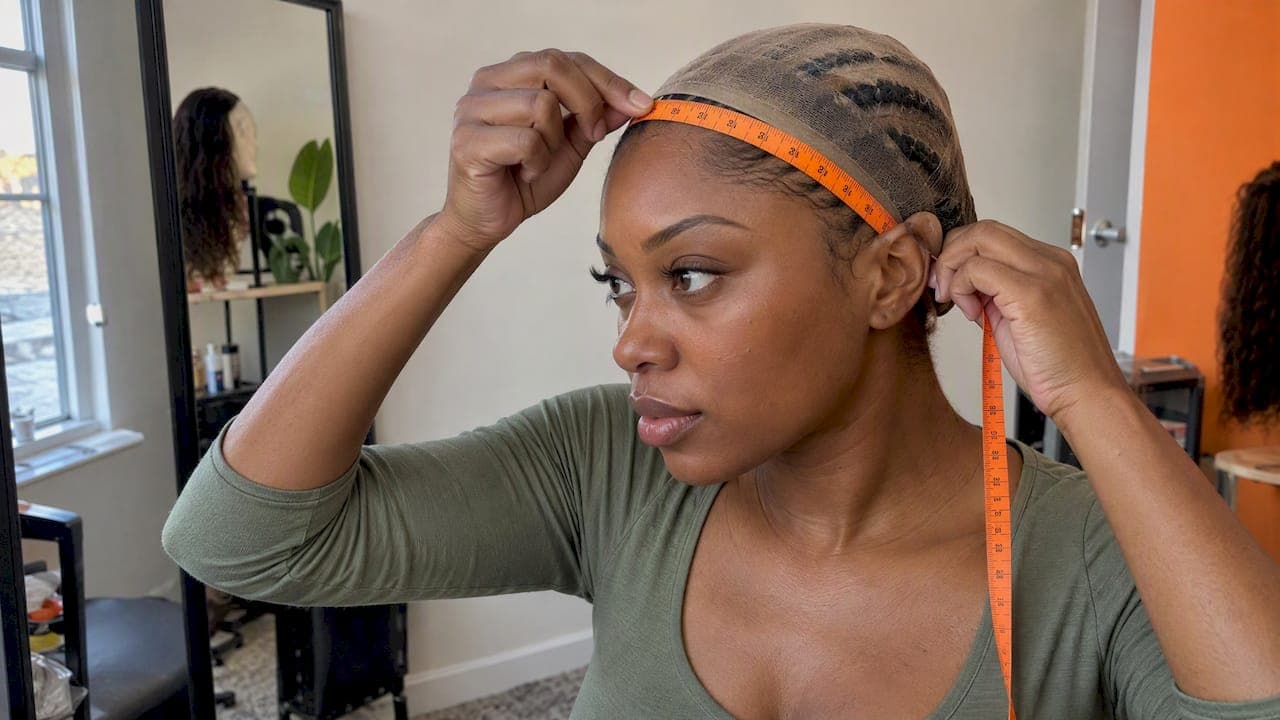
Most wig caps are sized by head circumference, measured in inches around your hairline, over your ears and across your nape. A standard adult cap runs about 21 to 23 inches. The catch for Black hair is that your measurement only means something when you take it over your hair in its wig-ready state: braided down, flat and smooth.
I remember ordering my first lace unit because the color and curl pattern were perfect. It arrived, and it sat on top of my head like a hat. The wig was fine. My measurements were not.
This guide walks you through measuring, reading a size chart, handling in-between sizes, and prepping your natural hair so the number you write down is the number that fits.
TL;DR
- Measure circumference first: start at the center of your front hairline, go over the ears, around the nape and back. It is the one number that decides your base size.
- Measure with your hair flattened the way it will sit under the wig, not loose or in a bun.
- Take each measurement two or three times, and if you land between sizes, go up.
- Sizes vary by brand, so always check the measurements on the product page, not just the word "medium."
- Preview the style on your own photo before you buy, so you are fitting a look you are sure about.
Table of Contents
- What a wig cap size actually tells you
- What you need before you measure
- Prep your hair first, because this is where most mistakes happen
- How to measure your head for a wig, step by step
- Reading the chart: where do you land?
- Why a cap size and "glueless" are connected
- When the cap is a little too roomy
- Common mistakes with wig cap sizing
- Perspective: fit is only half the decision
- Try the style before you buy the size
- A short checklist for wig day
- FAQ
- Sources
What a wig cap size actually tells you
A wig cap size is a promise about the inside of the unit: how much head it can wrap around. Brands label that with words (petite, average, large) or letters (S, M, L), and they attach an inch range to each.

One community thread on r/WigforGirl sums up what shoppers keep finding: most wigs come in a medium cap, and small and large usually sit an inch or two either side. That matches the broad pattern in published charts.
Here is a typical chart, based on 2024 guidance from True Glory Hair:
| Cap size | Head circumference |
|---|---|
| Child | 19 inches |
| Petite | 21 inches |
| Petite/Average | 21.5 inches |
| Average (medium) | 22 inches |
| Large | 23 inches or more |
Treat this as a starting map, not a verdict. Some brands go from XXXS to XL, and others lump everything into three sizes. A Hairalicious guide to size charts points out that one maker's large can be built for a smaller circumference but a longer front-to-nape than another maker's large, so the label alone says very little.
What you need before you measure
Keep it simple. You need:
- A soft, flexible measuring tape (the kind a tailor or sewist uses, not a metal one)
- A pen and paper, or your phone notes
- A mirror
- Your hair prepped flat
- Five quiet minutes
If you only have a metal tape measure, lay a piece of string around your head, mark it, and then measure the string against a ruler.
Prep your hair first, because this is where most mistakes happen
This is the step most size guides rush past, and it is the one that matters most for us.
Experts at Goldylost stress that you should flatten your natural hair as much as possible before measuring, with a braid-down, a wig cap liner, or pinning it flat. A bun or thick braids add bulk and distort your real head contours, which gives you a number that is too big.
For Black hair, the foundation decides everything. WIGI Hair warns that bulky cornrows or a poorly done beehive pattern can bend the cap shape and create a cone-head silhouette, no matter how accurate your measurements were.
Here is how I would prep, depending on your hair:
- Detangle and moisturize. A wig is not the time to ignore your hair. Work in your leave-in and seal your ends.
- Section and flatten. Flat cornrows going back, a low beehive pattern, or two-strand twists pinned flat all work. Keep the pattern thin and low.
- Smooth the edges. Lay your edges down gently. Do not pull or glue them for a measuring session.
- Add a thin wig cap. It holds everything in place and shows you your true wig-day shape.
- Remove anything bulky. Clips, headbands, scarves, high puffs.
If your style is a wash-day twist-out or a high puff, take it down or pull it back flat. The tape should sit where the edge of the wig will sit.
How to measure your head for a wig, step by step
1. Circumference
This is your main number. Guidance from Shirley's Wig Shoppe describes it this way: place the end of the tape at the center of your front hairline, run it just above one ear, around the nape of your neck, above the other ear and back to the start. The tape should be level and rest where the wig cap edge would sit.
Keep it snug, not tight. It should lie flat without squeezing your skin.
Wigs.com recommends repeating the circumference measurement two or three times before you consult a chart. Do that. If your numbers differ by half an inch, you probably moved the tape or changed your hair position. Average the readings or use the one you repeated most often.
2. Front-to-nape (optional but helpful)
Start at the center of your front hairline, run the tape over the crown and down to the nape of your neck. This tells you whether a cap will be long enough front to back, which matters for units with a specific cap length.
3. Ear-to-ear across the forehead and across the top
These two extra measurements help if you have a particularly wide or narrow forehead, or if a brand lists them in its chart.
Here is an honest note. Headcovers argues that circumference is the most important data point for base size, and that taking three or more measurements can create more confusion than clarity when the numbers do not line up. I agree for first-time buyers. Start with circumference. Add the others only when a brand's chart asks for them or when a wig fits strangely.
4. Write it down
Record your numbers in inches. Write down the date, too, and what your hair was doing (cornrows, flat twists, cap on). If you change your protective style a lot, your size can shift by a quarter to a half inch from one install to the next.
Reading the chart: where do you land?
Compare your circumference against the brand's chart, not a generic one. Then use these rules.
Between two sizes: go up. The industry advice, repeated by Goldylost, is to pick the larger cap to avoid pressure points. Forcing a smaller fit often makes the wig slide upward. Ceaux Hair gives the same instruction for lace closure and U-part wigs.
Slightly bigger is easier to fix than slightly smaller. Hairalicious notes that a slightly larger cap is usually not a problem for circumference, because adjustable straps and elastic can pull it in. A cap that is too small cannot be stretched into comfort.
Check the product page. Kristina Young Hair notes that exact dimensions can vary slightly even within one brand or collection because caps are constructed differently. Before you hit buy, look at the measurements listed on that specific unit.
Here is a quick decision table:
| Your situation | What to do |
|---|---|
| Circumference is right on a size line | Choose the larger size |
| You are 21 inches in a flat braid-down | Try petite or petite/average, and confirm the brand's range |
| You are 22 inches | Average or medium is usually your starting point |
| You are 23 inches or more | Large, and check if the brand offers extra large |
| You have a very full protective style and measured over it | Re-measure with a thin cap and a flatter base |
Why a cap size and "glueless" are connected
Many shoppers assume an elastic band turns any wig glueless. Not quite. Styles By Finn explains that a truly glueless unit depends first on accurate head measurements. When the cap matches your dimensions, it stays secure without harsh adhesives, and the elastic adds only secondary security.
That matters if you are protecting your edges. A cap that fits well means less tension, less adhesive and less reason to reach for glue when the wig starts to creep. If you are new to this, our list of glueless wig styles that are easy for beginners is a good next stop. If your hairline is already stressed, read our guide to low tension looks for thinning edges.
When the cap is a little too roomy
Sometimes you measure well and still feel a bit of extra space. A Luvme Hair beginner guide mentions wearing two thin wig caps to take up excess space and add stability. That only works for minor differences, and the caps need to be thin so you do not create bulk.
Try these in order:
- Tighten the adjustable straps at the nape.
- Add a second thin cap.
- Flatten your base further.
- If the wig still shifts, exchange it for the next size down, but only if the brand's range says your measurement fits.
If your hair is fine or thinning and you are weighing a wig against other options, it can help to compare clip-in extensions for thin hair, since fit and comfort work differently in each.
Common mistakes with wig cap sizing
- Measuring over loose hair. Natural volume adds inches that vanish under a cap.
- Pulling the tape too tight. You will order too small and fight pressure at your temples.
- Trusting the size name. Medium at one brand is not medium at another.
- Ignoring the base. A perfect measurement cannot rescue a lumpy foundation.
- Forgetting the style. A bob, a long body wave and a curly unit sit differently on the head, which is why length and shape matter too. Our wig length guide for Black hair explains how texture changes how long a wig reads once it is on.
Perspective: fit is only half the decision
We built StyleMyCrown because we saw the same story again and again. Someone spends hours getting the cap size right, buys the unit, installs it, and then realizes the style does not suit them. The cut was too heavy at the jaw, the color was off against their undertone, the part was in the wrong place.
Size is the part you can solve with a tape measure. Style is the part that feels personal, and it is usually the part people guess at.

That is why we treat measuring and previewing as two halves of one job. Get the circumference right so the wig stays put and your edges are not under strain. Then preview the look on your own photo before it is on your head, so you are not paying for a gamble. We curated more than 528 styles for different textures and types, because a catalog that only shows straight hair on a stranger tells you almost nothing about your own crown.
One more thing we care about: your face data is processed securely and never retained or used for AI training. Trying on a style should feel safe, not like handing something over.
— Christelle
Try the style before you buy the size
Once you know your cap size, test the look. StyleMyCrown lets you preview styles built for Black and textured hair on your own photo with augmented reality, and you start with 2 complimentary credits, so you can try a few looks with no commitment.
If you want to keep going after your free credits, the pricing plans include a 1 Week Trial at $17.48 per week and a 4 Week Plan at $38.73 per 4 weeks. You can also open the virtual try-on for Black and textured hair directly and start with a photo.
Browsing options? Our roundup of wig try-on apps for Black hair explains what to look for, and the lace front vs. closure comparison helps you pick a construction before you measure for it.
A short checklist for wig day
- Flatten your hair into a low, thin base.
- Put on a thin wig cap.
- Measure circumference two or three times with a soft tape.
- Compare to the brand's own chart.
- If you are between sizes, choose the larger one.
- Confirm the numbers on the exact product page.
- Preview the style on yourself first.
- Keep your numbers in your phone for next time.
That last one is small, but it saves you a lot of guessing when a style catches your eye at 11 p.m.
FAQ
How do I know what size wig cap to get?
Measure your head circumference from the center of your front hairline, over the ears, around the nape and back, with your hair flattened. Compare that number to the specific brand's chart. If you fall between two sizes, choose the larger one.
What is the standard size of a wig cap?
The most common adult size is average or medium, at roughly 22 inches in circumference, according to True Glory Hair's chart. Petite runs around 21 inches and large around 23 inches or more. Brands set their own ranges, so check the product page.
Should I measure my head with my natural hair down?
No. Loose hair, buns and thick braids add bulk and give you a number that is too large. Flatten your hair into a braid-down or pin it flat, add a thin cap, and then measure.
Do I need more than one measurement?
Circumference does most of the work for choosing a base size. Front-to-nape and ear-to-ear measurements can help if a brand asks for them or if a wig feels off even in the right circumference. Take every measurement at least twice.
Sources
- How do I choose the right wig cap size? (r/WigforGirl)
- How to Put on a Wig: Easy Guide for First-Time Wearers (True Glory Hair)
- Wig size chart explained (Hairalicious)
- Human Hair Wig Cap Size: Measure at Home (Goldylost)
- Wig Install Explained (WIGI Hair)
- How to Measure Your Head for a Wig (Shirley's Wig Shoppe)
- How to Measure Your Head for A Wig (Wigs.com)
- Wig Size Guide (Headcovers)
- Measure Your Head For a Wig (Ceaux Hair)
- FAQ (Kristina Young Hair)
- Beginners Guide To Glue Less Wigs (Styles By Finn)
- Luvme OwnScalp Braided Wig guide