
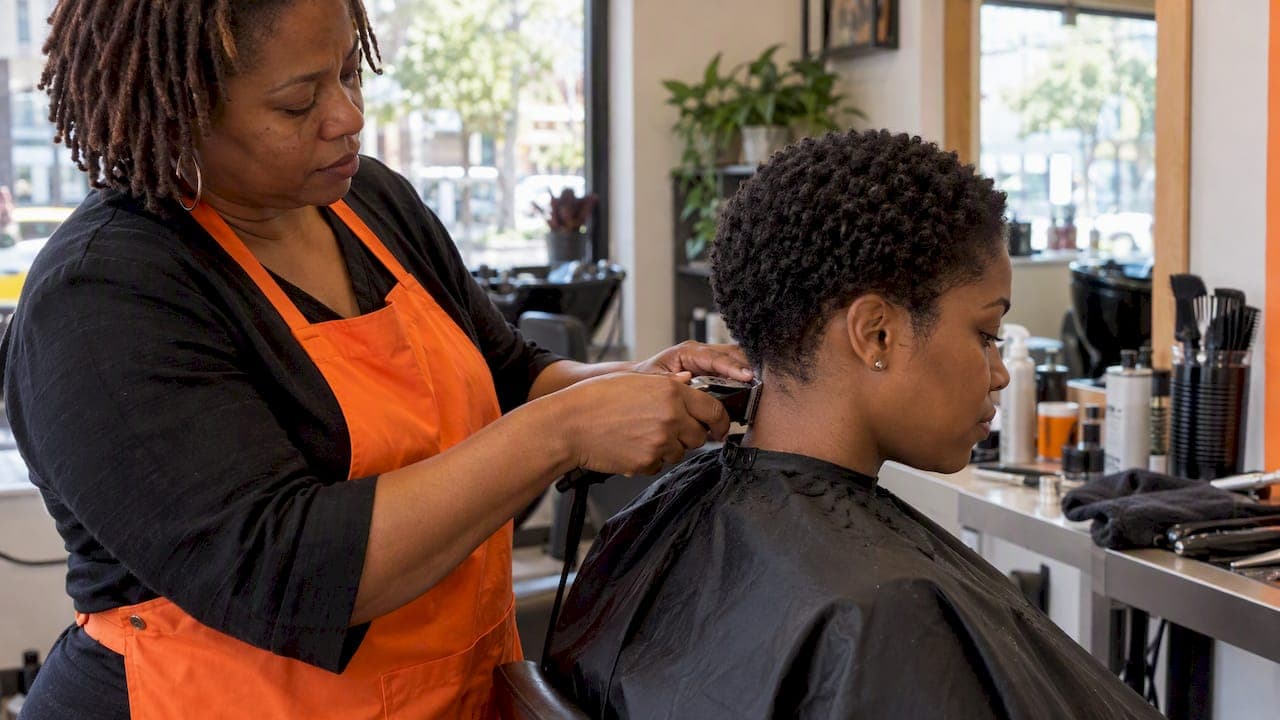
The best big chop hairstyles are the ones that suit your texture, your face and the amount of time you actually want to spend on your hair. For most people that means a TWA (teeny weeny afro), a tapered cut, a shaped pixie, or a short style with defined twists or curls on top.
The cut itself takes an hour. The hard part comes after, when you look in the mirror and ask what now.
I remember that moment. The floor around the chair is covered in hair, your head feels lighter, and you are not sure who is looking back. This guide is here for that moment, and for the weeks before it.
TL;DR
- A big chop is a cut that removes most of your length, often to remove relaxed or damaged hair. The popular shapes are the TWA, taper, pixie, shaved sides and a rounded shape-up.
- Taper and pixie are not the same thing: a taper is about short, graduated sides and back, while a pixie keeps more length on top and is shaped around the face. Many people wear both at once.
- Short styles lose their shape fast. Plan on trims every 2 to 4 weeks if you choose a fade or taper.
- Keep your routine simple: wash every 1 to 3 weeks, detangle gently, moisturize often, and see a dermatologist for thinning or scalp pain.
- Preview a few looks on your own photo before you sit in the chair.
Table of Contents
- What a big chop actually is
- The big chop styles worth knowing
- Taper vs. pixie: how to choose
- Upkeep nobody warns you about
- Find the right stylist and cut dry
- Caring for short hair after the chop
- Chop now or transition first?
- Our perspective
- Preview your big chop first
- Fitting your life around the new length
- A checklist before you sit in the chair
- FAQ
- Sources
What a big chop actually is
A big chop is a dramatic cut that takes you from long hair to short in one appointment. People do it to leave relaxers behind, to get rid of heat damage, or simply because they want a reset. Hey Curl Hey notes that some chops come after boredom, a breakup or heat damage, not only after a long transition.
It is not only a removal. Stylists often describe it as a discovery of your real curl pattern. As Allure's big chop guide explains, you will only see your true texture, density and shrinkage once damaged ends are gone.
That can be a surprise, in a good way. The coils you thought were "loose" may be tighter. The front may curl differently than the nape. Give it a few weeks before you decide who you are as a short-haired person.
The big chop styles worth knowing
Here are the shapes I see most, with what each one asks of you.
The TWA
The teeny weeny afro is the classic. You leave a small, even layer of hair all over and let it be round and soft. It works with almost any texture, and it is the easiest place to start because there is not much to get wrong.
Styling options: a wash and go with a light curl cream, finger coils, or a defined shape with a soft brush. Hey Curl Hey's TWA roundup is a good place to browse variations.
The taper
A taper keeps the top fuller and graduates the sides and the nape shorter. The line can be subtle or sharp. It frames the face, shows off your hairline and your cheekbones, and looks polished with very little styling.
The trade-off is upkeep. More on that below.
The pixie
A pixie keeps more length on top and often more length at the front, with shorter sides. On textured hair, the shape matters more than the length. A pixie cut on 4C hair looks very different from one on looser curls, and a cut designed for straight hair can go wrong fast. We wrote a whole guide on short pixie cuts for Black hair if this is the direction you are leaning.
Shaved sides or an undercut
Shaved sides give you room to be creative. You can keep the top long enough for twists or twist outs while the sides stay clean. According to Natural Hair for Beginners, shaved sides are a very popular look on natural hair and an easy canvas for a line or two of design.
The buzz cut or low cut
The boldest choice. It is also the cleanest reset, and some people choose it first and grow into a TWA. If you want the sense of a blank page, this is it.
Short twists, coils and twist outs
Once you have about two to three inches, you can start styling. Natural Hair for Beginners lists twist outs, braid outs and flat twist outs as options that work on freshly washed or older short styles, with small or chunky sections.
Taper vs. pixie: how to choose
People search "tapered vs pixie" because the two look close on a photo and are cut differently. Here is how I would explain it to a friend.
| Taper | Pixie | |
|---|---|---|
| Main idea | Sides and back graduate shorter | Short overall, with more length on top and front |
| Look | Clean, sculpted, structured | Soft, feminine or edgy depending on the shape |
| Styling | Define curls or coils on top | More room for texture, side parts and fringe |
| Upkeep | Frequent trims to hold the line | Regular shaping, usually less sharp |
| Best if | You love structure and a crisp edge | You want options and some length to play with |
The two overlap. A tapered pixie is common: short, graduated sides with a longer top. The better question is not which name you pick but what you tell your stylist: how short at the sides, how much length on top, and where you want the hairline to sit.
If you need help on the shape of the face, a try-on helps more than a description. I will get to that below.
Upkeep nobody warns you about
Short hair feels like low maintenance. Often it is not.
A fade or taper loses its shape quickly. According to Allure, structured short cuts often need a trim every 2 to 4 weeks to hold the silhouette, and skipping that can leave you with an accidental mullet. That discourages many people early in their natural journey, so budget for it before you choose.
A TWA or a rounded shape is more forgiving. If you do not want a standing barber appointment, ask your stylist for a softer cut that grows out gracefully.
Find the right stylist and cut dry
Step one, according to Allure, is finding a stylist who knows how to work with your texture and your goals. Ask to see photos of their work on hair like yours.
Ask about a dry cut, too. The same Allure piece explains that cutting wet or stretched hair can hide the different curl patterns on one head and leave you with an uneven shape once the hair dries and shrinks. A dry cut helps avoid the pyramid effect.
Bring references, and bring more than one. Show your stylist the front, the side and the back, and say what you do not want as clearly as what you do.
Caring for short hair after the chop
Your routine can be simple. It needs to be consistent.
- Wash gently. The British Association of Dermatologists suggests washing every 1 to 3 weeks and detangling with a wide-toothed comb or your fingers.
- Moisturize. The same guidance recommends moisturizers such as shea butter, olive oil or glycerin, because scalp oils have a harder time traveling down tightly coiled hair than straight hair.
- Be patient with growth. Cutting does not change how fast hair grows. The Cleveland Clinic says hair grows about 0.5 to 1 inch per month, and that the rate is genetically determined, not changed by cutting.
- Go easy on tension. Tight braids and weaves can cause traction alopecia. If a style hurts while it is being installed, the stylist should stop, according to BAD.
If you notice thinning, scalp pain or an unexpected texture change, do not just switch hairstyles. The same dermatologist guidance flags central centrifugal cicatricial alopecia and traction alopecia as serious concerns, and early treatment matters to prevent scarring. See a dermatologist, ideally one who treats textured hair and scalp conditions.
A short style also shows your scalp, so a calm, healthy scalp is part of the look. Earrings help too. A bold pair can finish a short cut the way a scarf finishes an outfit, and this guide to earrings for short hair goes through hoop sizes and lightweight options that sit well with a cropped style.
Chop now or transition first?
This is the question under every other question. There is no right answer, only yours.
Cosmetologist Sophia Emmanuel, quoted by Glamour South Africa, says the choice depends on your hair length, your patience and your emotional connection to length. The same piece points out that the hardest part of transitioning is managing the line of demarcation, where two textures meet.
That line is where breakage happens most. Hello Beautiful advises working in very small sections, using lots of slip and keeping hair hydrated so the processed hair does not snap under the weight of the new growth.
If you want to keep your length for now, we collected options in our guide to transitioning hairstyles. If you are ready, a trim is not required. Glamour notes that professional, gradual trims are the standard route for people who are not ready for an immediate reveal, and the big chop is the quick one.
Our perspective
We built StyleMyCrown because we know how this feels from the inside. The big chop is one of the most exposed decisions a person with textured hair can make. You cannot undo it with a clip or a wig cap, and most hair apps were never built for 4C coils, so the previews look like someone else's hair on your face.
So we do one thing differently. Our catalog holds over 528 styles curated for different textures and types, with looks that reflect the Global Diaspora. You try them on your own photo using augmented reality before you commit to a stylist or a pair of clippers.

We also care about what happens to your face data. It is processed securely and never retained or used for AI training. A photo of your face is personal, and so is a haircut like this.
My advice, as someone who has watched many people take this step: preview three shapes, not one. Pick the one you keep returning to. Then book a stylist who will cut it dry and talk through upkeep before the first snip. The look matters, and so does the plan that comes with it.
— Christelle
Preview your big chop first
If you want to see a taper, a pixie or a TWA on yourself before the appointment, StyleMyCrown's virtual try-on is built for Black and textured hair. New users get 2 complimentary credits, so you can test a few looks without paying.
When the free credits are used, the plans on the pricing page include a 1 Week Trial at $17.48 per week and a 4 Week Plan at $38.73 per 4 weeks. There is also a 12 Week Plan, which has no published price.
For more short-hair ideas, see our guide to short natural hairstyles you can preview.
Fitting your life around the new length
A few practical notes that tend to matter in the first months.
Work and school. Short, defined hair reads as polished almost anywhere. A tapered shape needs the least effort on busy mornings, as long as you keep the trims on the calendar.
Kids. If a parent is choosing for a child, show them photos and let them point. It sounds small. It is not. A child who picks the cut feels proud of it.
Black men. A taper, a low cut or a short twist set are all part of the big chop family. The same rules hold: find a barber or stylist who handles your texture, and preview before you commit.
Growing out. When you are ready for length again, short weaves or protective styles can bridge the gap. Our guides to short weave styles and protective hairstyles cover options, and low-tension choices protect your edges while you grow.

Low effort days. If you want fewer decisions, see these low maintenance Black hairstyles.
A checklist before you sit in the chair
- Decide your reason. Resetting, leaving a relaxer, or just a change? The reason shapes the cut.
- Choose three reference photos on hair like yours, and preview them on your own photo.
- Book a stylist who works with your texture, and ask about a dry cut.
- Ask how often you will need a trim to keep the shape.
- Stock gentle basics: a moisturizer, a wide-toothed comb, a satin bonnet or pillowcase.
- Give yourself a few weeks of grace before judging the result.
Then walk out into the light. It feels different out there.
FAQ
What is considered a big chop haircut?
A big chop is any dramatic cut that removes most of your length in one go, usually down to a TWA, taper, pixie or buzz cut. It is often done to remove relaxed or damaged hair and start from your natural texture.
Is it better to do the big chop or transition?
Neither is better. It depends on how much length you want to keep, how patient you are with the line of demarcation, and how you feel about short hair. If you transition, plan for small sections, plenty of slip and gradual trims. If you chop, plan for upkeep and a new routine.
Does your hair grow faster after a big chop?
No. The Cleveland Clinic says hair grows about 0.5 to 1 inch per month, and cutting does not change that. Short hair can look like it grows quickly because the changes in length are easier to see.
What should I do with my hair after a big chop?
Keep it simple: wash every 1 to 3 weeks, detangle with your fingers or a wide-toothed comb, and moisturize often. Then try a wash and go, twist out or finger coils. If you want a style to look at before committing, preview a few on your photo. If you notice thinning or scalp pain, see a dermatologist.
How often do I need to trim a tapered cut?
Structured short cuts often need trims every 2 to 4 weeks to keep their shape, according to Allure. A softer TWA is more forgiving and can go longer between appointments.
Sources
- Big Chop: How to Make the Cut, Allure
- Caring for Afro-textured hair, British Association of Dermatologists
- Does Shaving Make Hair Thicker?, Cleveland Clinic
- How to successfully transition from relaxed to natural hair, Glamour South Africa
- Growing Out Relaxed Hair?, Hello Beautiful
- 40 Tempting TWA Hairstyles, Hey Curl Hey
- Short Hairstyles, What To Rock After The Big Chop, Natural Hair for Beginners