
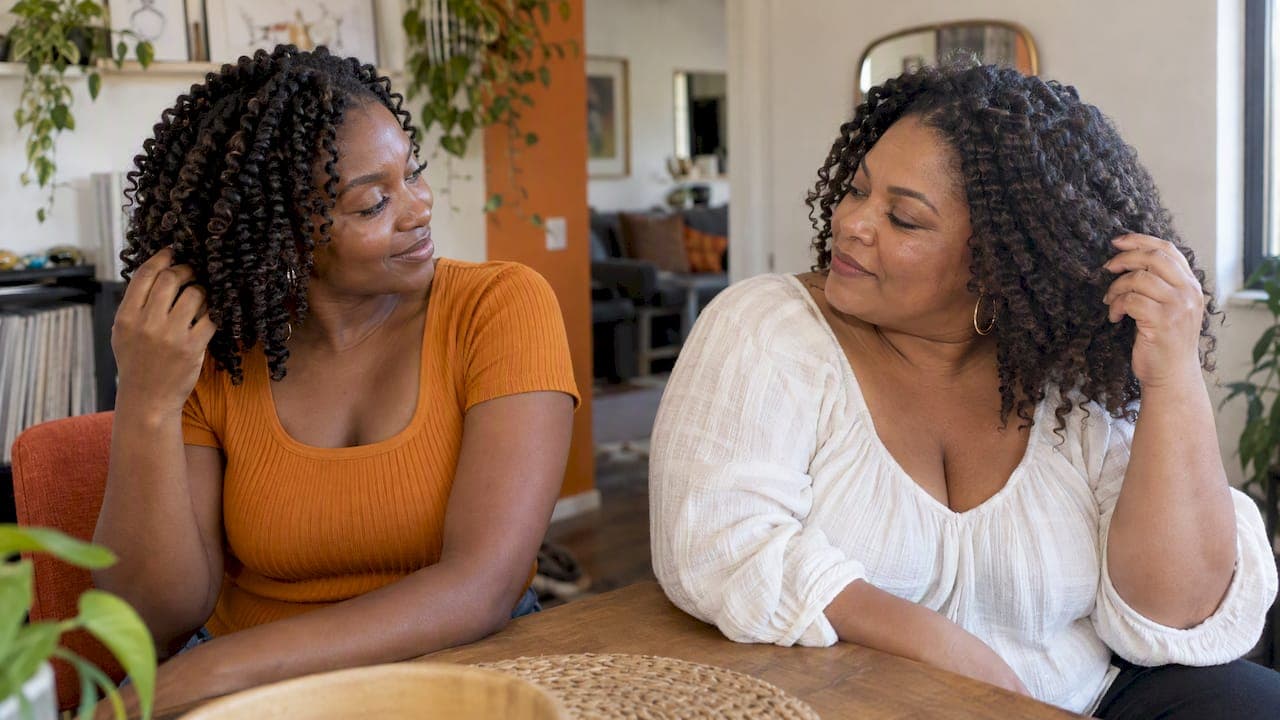
A braid out gives you more stretch and usually a longer-lasting, more defined pattern. A twist out gives you softer, fuller volume and is usually quicker to put in. Neither is better across the board. The right one depends on your texture, your length, how long you need the look to hold, and how your edges feel on day one.
I have stood in a bathroom at 11 p.m. with a rat-tail comb, a jar of butter and a plan, only to wake up and unravel a set that looked nothing like the picture in my head. Most of us have. So this guide is about choosing before you spend the evening, and about doing either style without paying for it in your edges later.
TL;DR
- Braid outs tend to stretch hair more and hold definition longer, often 3 to 7 days with good nighttime care.
- Twist outs tend to be faster to install and look softer and fuller, but can lose definition sooner on tighter 4b and 4c textures.
- Two-strand twists are generally gentler on fragile edges, but any set that hurts is too tight, whatever the pattern.
- Your hair must be fully dry before you unravel. That one step decides most of your frizz.
- You can preview both looks on your own photo before you commit an evening to either.
Table of Contents
- What actually separates a twist out from a braid out
- Twist out vs braid out at a glance
- How your texture changes the answer
- Tension, edges and what the dermatologists say
- How to install either one without regret
- The take-down that makes or breaks the look
- Making it last, and knowing when to stop
- How to choose: a quick decision guide
- Our perspective
- Preview the look before you set it
- FAQ
- Sources
What actually separates a twist out from a braid out
Both are setting styles. You twist or braid damp, moisturized hair, let it dry in that shape, then take it down to reveal a pattern. The finished look is the unraveled hair, not the twists or braids themselves.
The difference starts in the pattern. A braid uses three strands interlocked. A twist uses two strands wrapped around each other. That small change shapes everything you see afterward:
- Three strands make a tighter, more compact pattern that creates a crimped, wavy-to-coily result with more elongation.
- Two strands make a looser wrap, which usually gives bouncier, rounder curls and more body.
Both are also done without direct heat, which is a big reason people with textured hair reach for them. If you want the broader picture of twisted styles you can wear in, not just take out, our guide to twist hairstyles for Black hair covers sizing and care.
Twist out vs braid out at a glance
| Factor | Braid out | Twist out |
|---|---|---|
| Pattern | Crimped, wavy, more defined coils | Rounder, bouncier, softer curls |
| Stretch | More | Less |
| Volume | Moderate, can be sleek | Fuller, more body |
| Install time | Usually longer | Usually faster |
| Hold | Often 3 to 7 days with care | Often shorter, especially on 4b and 4c |
| Frizz tendency | Can show more frizz as it ages | Can lose definition sooner |
| Edge friendliness | Fine when loose, risky when tight | Generally gentler |
These are tendencies, not rules. Guides don't fully agree on every row. Some name twist outs as the definition winner, others name braid outs, and the split mostly comes down to texture and technique. Treat any chart, including this one, as a starting point and test on your own head.
How your texture changes the answer
Texture is where most arguments online start, and where most of the useful advice lives.
4b and 4c hair
Tightly coiled hair shrinks a lot. A braid out is a popular answer because it stretches the hair and can keep its definition longer. Byrdie's breakdown notes that twist outs can lose definition faster in tighter textures. If you are 4c and have been disappointed by a twist out that puffed up by day two, try a braid out with medium sections before you give up on the idea.
Smaller sections give more definition on any texture, but they take longer to install and to take down. Bigger sections give a softer, more blended finish. Pick the size that matches how much time and patience you have, not what a stranger's video promised.
If you want styles built around these textures, see our picks for 4C hairstyles and 4B hairstyles that actually work.
3c to 4a hair
Looser coils already have a pattern. A twist out often looks beautiful here because it shows off what you have and adds body without crimping it into something different. A braid out can still work, but it can read more textured and less springy than your wash-and-go.
Locs
Both methods are done on locs too. Braid outs and twist outs on locs give a wavy, crimped or spiraled look without any change to the locs themselves. It is the same logic: three strands for a tighter pattern, two for something softer. Keep the same tension rules, because locs can be pulled at the root just as easily. Our locs maintenance guide covers scalp safety in more depth.
Transitioning hair and big chops
If you are growing out relaxed ends or you recently cut, a twist out is often kinder at the line where two textures meet, because the softer pattern blends them. You can find more ideas in our list of transitioning hairstyles.
Tension, edges and what the dermatologists say
Here is the part nobody wants to skip past, so I won't.
The American Academy of Dermatology explains that hairstyles that constantly pull on the hair can lead to hair loss. A 2016 review in the Journal of the American Academy of Dermatology on black hairstyling practices and traction alopecia describes it as prevalent among Black women, a type of hair loss tied to certain styling practices. Traction alopecia is not an abstract risk. It is the thinning at the hairline and temples that many of us have watched happen to someone we love, or to ourselves.
What that means for these two styles:
- The style is not the enemy. The tension is. A loose braid out is far safer than a tight twist out.
- Pain on day one is information. If the hairline or nape hurts, stinging, or you see small bumps at the base of sections, tell your stylist to stop, or loosen it yourself. Sore does not mean it is working.
- Tighter does not mean longer lasting. That belief is common and cultural, and it is the one worth retiring. Experts quoted by Allure point to lower-tension methods like knotless braids as a way to get the look without gripping the root.
Because braids interlock three strands, they can tempt people to pull harder at the start to keep them neat. Two-strand twists are generally gentler on fragile edges, though the same rules apply. For either, leave your edges and hairline sections out or set them very loosely.
If you already see thinning, or you have a scalp condition, see a board-certified dermatologist before you set anything. Don't wait for it to grow back on its own while you keep styling the same way. Our guide to low-tension looks for thinning edges can help you plan what to wear in the meantime.
How to install either one without regret
The steps are nearly identical. Where they differ is the pattern in step four.
- Start clean. Wash and deep condition first. A Baylor College of Medicine dermatologist advises washing thoroughly and deep conditioning before adding tension, and detangling well to minimize knots.
- Keep it damp, not soaking. Section your hair on damp, moisturized strands. Soaking wet hair takes forever to dry and invites frizz.
- Moisturize, then seal. Use a leave-in and a light cream or butter. Heavy product on every section can leave you with sticky, flaky definition.
- Part and pattern. Make even parts. Braid in three strands for a braid out, or twist two strands for a twist out. Finish the ends around a finger or a flexi rod if you want a curl at the tip.
- Stay loose at the root. If you can feel it pulling when you smile, redo it.
- Let it set. Sleep in a satin bonnet or scarf, or sit under a hooded dryer. Byrdie notes that pros often use a dryer for 30 to 60 minutes to complete the set.
For more on the setting and maintaining side of twist outs, this walkthrough on setting and maintaining twist outs offers useful technique detail on getting defined curls without heat.
The take-down that makes or breaks the look
Most disappointing sets were ruined at the take-down, not the install.
Make sure it is fully dry. If your hair still feels cool or slightly damp at the root after the night, it is not ready. Unraveling too early is one of the biggest causes of frizz and lost definition, no matter which product you used.
Oil your fingers first. A little jojoba, argan or coconut oil on your fingertips cuts down friction before you touch a single section.
Go from the ends up. Start at the bottom of each twist or braid and unwind toward the root. Opening from the ends prevents sections from knotting against each other at mid-shaft, which is where much of the breakage happens.
Do not rake or comb it out. Separate gently with your fingers, and only where it needs it. Fluff at the root with a pick or your hands if you want volume, and leave the rest alone. The more you touch it, the faster it frizzes.

Making it last, and knowing when to stop
A braid out may stay presentable for 3 to 7 days with proper nighttime care. A twist out often gives you a shorter window, depending on your texture. Either way, here is what extends the life:
- Pineapple or loosely bun your hair at night, then cover it with satin.
- Skip heavy products when you refresh. Mist with water and a little leave-in, then redefine problem sections with a few twists.
- Keep your hands out of it.
At some point the style is done. If you are adding product to cover buildup, it is time to wash. The AAD advises washing every week or every other week and conditioning every time, because buildup can dry out hair and irritate the scalp. Wash day is not the enemy of your style or your length. A healthy scalp supports the hair you are trying to keep.
Naturally dry textures need extra attention here. The British Association of Dermatologists explains that the tight curl pattern of Afro-textured hair makes it more prone to dryness, because scalp oils travel less easily down the strand. That is why moisture at install matters so much for both styles.
How to choose: a quick decision guide
Pick a braid out if:
- You have 4b or 4c hair and want more stretch and a longer hold.
- You want a crimped, wavy texture.
- You can give the install a bit more time.
Pick a twist out if:
- You want fuller, softer curls with more body.
- You want a quicker set.
- Your edges are tender and you want the gentler pattern.
- You have looser coils that already have a nice shape.
Still unsure? Do half a head of each. Braid one side and twist the other, take them down together, and you will learn more about your own texture in one morning than from any comparison article, including this one.
And if you are weighing a set you wear for days against a protective style you wear for weeks, our comparison of braids vs twists for Black hair breaks down short-term and longer-term wear.
Our perspective
We built Stylemycrown because choosing a look for Black hair has always felt like a gamble. You see a style on someone with a different texture, a different density, a different hairline, and you wonder if it will look like that on you. Then you spend hours and money finding out.
Twist outs and braid outs are a perfect example. They look different on every head, and you cannot know which suits you until you wear them. That is why we think the smartest step comes before the first part is made: look at the style on your own face and your own hair type, then decide. It will not replace a good stylist or the feel of your own hands in your hair, but it can save you a wasted evening.
We also want you to protect what you have. A look is not worth a thinning hairline. If a style hurts, take it down. Your crown is worth more than a photo.
— Christelle
Preview the look before you set it
Stylemycrown is an AR virtual try-on made for Black and textured hair, with a catalog of over 528 styles curated for different textures and types. Upload a photo, try styles on yourself and see what suits your face and your needs. Your face data is processed securely, and we do not retain it or use it for AI training.
You start with 2 complimentary credits. After that, the 1 Week Trial is $17.48 per week, and the 4 Week Plan is $38.73 per 4 weeks. A 12 Week Plan is also offered. See the plans or try the virtual hairstyle try-on first.
Stylists can use it as a digital catalog to cut down consultation time, and parents can use it to preview styles for their kids before booking a long sit.
FAQ
Which is better, a twist out or a braid out?
Neither wins every time. Braid outs usually stretch hair more and may hold definition for 3 to 7 days, which helps on 4b and 4c textures. Twist outs are usually faster and give softer, fuller curls. Choose by texture, time and how your edges feel.
Is a twist out or braid out safer for my edges?
Two-strand twists are generally gentler on fragile edges, but tension matters more than pattern. Dermatologists say pain, stinging or bumps at the base mean the style is too tight. Loosen it or take it down, and see a dermatologist if you notice thinning.
Why does my twist out frizz or lose definition so fast?
The most common cause is unraveling before your hair is fully dry. Heavy product, over-handling and skipping a satin covering at night also play a part. Oil your fingers, take sections down from the ends and leave the hair alone once it is fluffed.
How often should I wash when I wear these styles?
The American Academy of Dermatology suggests washing about once a week or every other week for Black hair, and conditioning each time. Washing between sets helps prevent buildup that can irritate your scalp. Try to wash before a new set, not after weeks of layered product.
Sources
- Braid-Outs vs. Twist-Outs: Which Style Is Right For You? (Byrdie)
- Hairstyles that pull can lead to hair loss (American Academy of Dermatology)
- All hairstyles are not created equal (Journal of the American Academy of Dermatology)
- How to heal scalp irritated by protective styling (Allure)
- Braids for curly and coily hair: Baylor dermatologist weighs in (Baylor College of Medicine)
- Black hair: Tips for everyday care (American Academy of Dermatology)
- Caring for Afro-textured hair (British Association of Dermatologists)